
Hybridity and roots - TLS
 Curated from:
www.the-tls.co.uk
Curated from:
www.the-tls.co.uk
Ideas, facts & insights covering these topics:
13 ideas · 6 reads
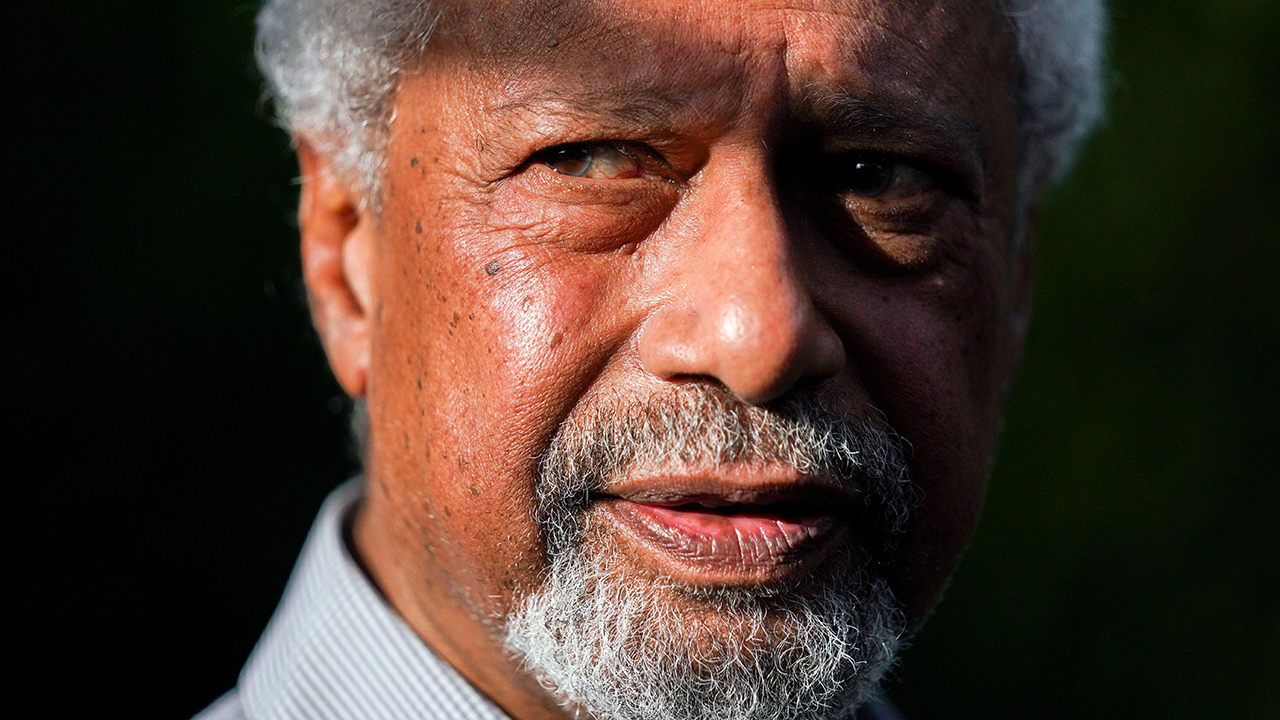
Hybridity and roots
The salient ideas, elegant writing and ethical commitment of this year’s Nobel laureate, Abdulrazak Gurnah.
Few announcements could give greater pleasure to followers of the broad church of African literature than that of the East African-born novelist Abdulrazak Gurnah as winner of this year’s Nobel Prize in Literature.
We would all like to give the honorific Swahili greeting shikamoo – “I touch your feet” – but we can’t do that literally right now, and he wouldn’t like it anyway, I reckon, being a very self-effacing man, despite his great talent.
By Giles Foden
Born in 1948 on Zanzibar, then still a British colony, Gurnah came to the United Kingdom in 1968. This was the year of Enoch Powell’s “Rivers of Blood” speech and four years after the violent Zanzibar revolution that eventually led to the union of Zanzibar and Tanganyika as present-day Tanzania – a moment later dramatized in his debut novel, Memory of Departure (1987). He studied at Canterbury Christ Church University and earned a PhD at the University of Kent in 1982, before teaching for a few years at a university in northern Nigeria.
He then returned to Kent, rising through troublesome academic ranks to become Professor and Director of Graduate Studies, until his retirement in November 2018, an occasion on which I was honoured to give a valedictory lecture. At the end of that peroration, I rashly predicted the likelihood of Nobel laurels. The best bet I never made. Gurnah’s academic work during this period, like that of his fellow laureate J. M. Coetzee, focused on colonial and post-colonial writing – branching out, when the field went mainstream, into some creative-writing tuition.
All through this time – the early part of which saw post-colonial writing going against the grain of predominantly white, neocolonial establishment authority – Gurnah was writing groundbreaking fiction. To date, he has produced ten novels that grapple with the subjects of the immigrant experience, displacement, memory and colonialism. These concerns – the transnational, the trauma narrative – are very current now, but they were just a speck on the horizon when Gurnah began developing his oeuvre. He was a prime mover in this respect, and that is part of what has catalysed this award.
As the chair of the Nobel committee, Anders Olsson, remarked, “Gurnah has consistently and with great compassion penetrated the effects of colonialism in East Africa, and its effects on the lives of uprooted and migrating individuals”.
This element of compassion was clearly an important factor for the Nobel committee. Gurnah has never been a culture warrior in his public pronouncements, and his fiction has always extended generously to “the other point of view”. Yet close reading of his work reveals a forceful rejection of those championing fixed ideas about concepts such as identity.
This applies both to colonial oppressors – or today’s right-wing racists – and to those on the left seeking to make a brute singularity out of immigrant or post-colonial experiences for political gain. The author is fastidiously fair in his sarcasm and disdain. As my colleague at the University of East Anglia, Alison Donnell (for many years a friend of Gurnah’s) has put it, his work displays “a great serenity, a beautifully understated style that slows me down”.
Another reason for the Nobel accolade might be Gurnah’s ability to fictionalize both colonial experience (as in his novels Paradise, 1994, Desertion, 2005, and Afterlives, 2020) and post-colonial experience (as in Dottie, 1990, Admiring Silence, 1996, and The Last Gift, 2011). Via his depictions of the latter he explored such themes as asylum, British racism and the residual effects of Empire – this last corrosion influencing so much of our present polity in Britain. Expect more on that soon from Gurnah, perhaps.
Tanzania has got off no more lightly than Britain in Gurnah’s work. It will be interesting to learn how that deeply polarized country welcomes its first Nobel laureate. Of Admiring Silence, in which the narrator must return to Zanzibar, by then part of Tanzania, Andrea Ashworth wrote in the TLS: “reassuring and romantic ‘Empire stories’ are thrown into stark relief by the reality of the squalor in his ‘knackered land’, presided over by ‘home-grown bullies’ and rife with inter-racial resentment.
His sense of exile is exacerbated as he wanders over the rubble of his family’s town and is forced to discard his own ‘ameliorating and hopeful’ fictions about ‘home’”.I wrote in the Guardian, in relation to The Last Gift, of how these tensions – between the half-distant colonial past and the post-colonial, exiled present – cannot be easily reduced. I wrote: “Elements of The Last Gift reject outright that storytelling salve which, acting both as a glue between cultures and a way of sliding across boundaries, has characterised much postcolonial literature …
Dispersed more widely across the novel is a suggestion that, while proliferating stories might be good for dealing with hybridity, there is a countervailing need for fundamental roots”.These questions about roots, authenticity and hybridity are portrayed in Gurnah’s work more often as external social or familial demands than as a personal endogenous need, contrasting with the prevailing view of identity today.
The background to that reluctance to embrace an individual sense of identity (and a wish that we weren’t all so dependently forthright in requiring validation) crystallize around Gurnah’s approach to the colonial moments he has so brilliantly dramatized; above all, there is an implicit request that at least those who opine about both colonialism and post-colonialism absorb their joint histories.
As the Ethiopian novelist Maaza Mengiste, herself no slouch in these matters, wrote in the Guardian of Gurnah’s most recent novel Afterlives: “Gurnah is known for decentring European history: a structural decision that is also politically potent. In Afterlives, he considers the generational effects of colonialism and war, and asks us to consider what remains in the aftermath of so much devastation. What can be salvaged when one of the consequences of colonialism is the deliberate exclusion of an African perspective from the archives?”
With his consideration of these ideas, so salient today, the elegance of his writing, and his vigilance to ethical issues, without tub-thumping, it is clear why Abdulrazak Gurnah is this year’s rightful Nobel laureate.
Giles Foden’s most recent novel is Freight Dogs, which was published earlier this year
Nobel Prize