Ep. 2 - Awakening from the Meaning Crisis - Flow, Metaphor, and the Axial Revolution
Curated from: www.youtube.com
Ideas, facts & insights covering these topics:
6 ideas · 426 reads
Axial Revolution
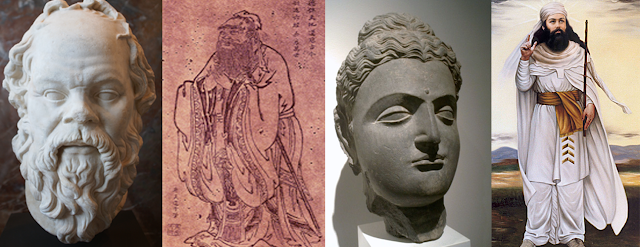
Is the period after the Bronze Age, when at the same time around the world, the great intellectual, philosophical, & religious systems that came to shape subsequent human society emerged—with the ancient Greek philosophers, Indian gurus (creators of of Hinduism & Buddhism), Persian Zoroastrianism, the Hebrew Prophets, the “Hundred Schools” (Confucianism & Daoism) of ancient China.
The phrase originated with the German philosopher Karl Jaspers, who noted that during this period there was a shift—away from more predominantly localized concerns and toward transcendence.
Archaic Learning: Implicit, Intuitive, Metaphorical
Implicit learning refers to the process of acquiring knowledge about the structure of the environment without conscious awareness. Like how we learn to ride the bike. Explicit learning is a conscious operation where the individual makes & tests hypotheses in a search for structure. Like how we learn math.
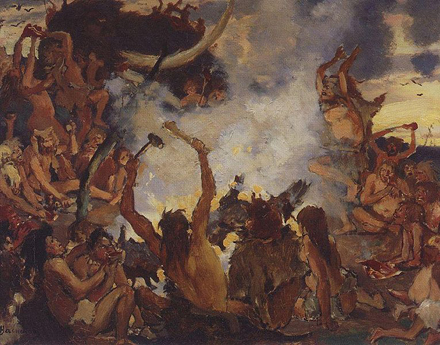
During the Palaeolithic times, knowledge was 100% implicit. There was no abstract thought, patterns were recognised intuitively and expressed in metaphors. Shamanic rituals was how knowledge was passed around.
The Axial Revolution will introduce abstract thought & explicit learning.

The power of metaphors
Creativity is when different parts of your brain connect. It's what happens when we are in a state of flow, during meditation or in psychedelic experiences.
Metaphors is how we do that in language. Most of our language is metaphorical. We ask "Do you see what I am saying". We say "Hope this is not hard for you" or "This is the middle of my talk". Most of what we say are metaphors.
Metaphorical thought, your ability to make analogies, is a measure of a good problem solver. The smart people make interesting connections.
Second Order thinking
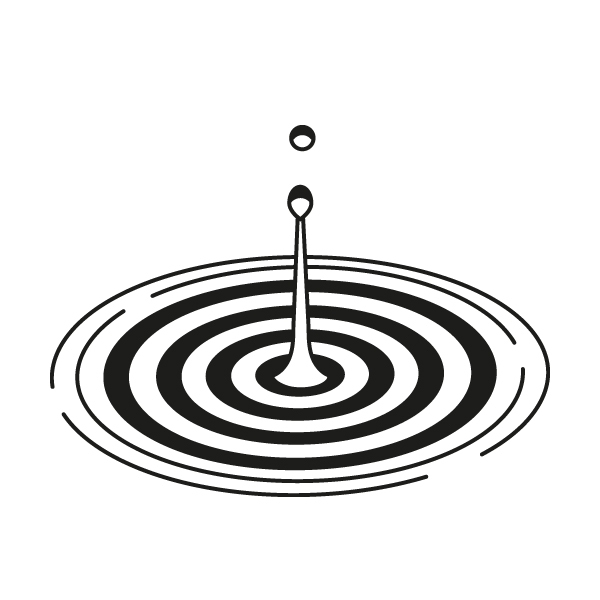
Second order thinkers ask themselves the question “And then what?” It is a form of meta-cognition that allows for investigation of our own thinking.
It became a thing during the Axial Revolution, when writing allowed us to store our thoughts, reflect on them and communicate with others across time and space.
Money as a psycho-technology
As people started trading more and more during the ancient times, money became used. And coinage was a massive cognitive upgrade:
- Money popularises abstract thought. Accepting an abstract representation of value was a massive shift for the time.
- Money makes people think mathematically.
Transcendence during the Axial Revolution
Transcendence means “to go beyond.” In the case of the Axial “revolution”, “going beyond” has several meanings:
- a shift to thinking about the cosmos and the way it works rather than taking for granted that it works
- the rise of second-order thinking about the ways that human beings operate, realising both that we are lying to ourselves and that we can improve ourselves.
It's why the transcendent thinkers of the Axial Age: Buddha, Plato etc ... are still relevant today.