Connect
Curated from: play.google.com
Ideas, facts & insights covering these topics:
17 ideas · 24.4K reads

Exceptional relationships
Exceptional relationships can be developed. They have six hallmarks:
- You can be more fully yourself, and so can the other person.
- Both of you are willing to be vulnerable.
- You trust that self-disclosures will not be used against you.
- You can be honest with each other.
- You deal with conflict productively.
- Both of you are committed to each other’s growth and development.
In these relationships, you feel seen, known, and appreciated for who you really are, not an edited version of yourself.
A learning mindset
It has several characteristics.
- One is a willingness to let go of the idea that your way of doing things is always best.
- Another is being game to try new things and take the risk of making mistakes.
- A third is seeing mistakes as learning opportunities rather than something to be embarrassed about and hide. Curiosity is key.
Having an open mind for continuous learning is a wonderful way to live. It means you’re open to your own development.
Letting yourself be more fully known
Most of us have countless interactions each day with people who don’t really know us well. At times, you may yearn for deeper and more meaningful connections, but you don’t always know how to get there.
Letting yourself be more fully known is crucial to developing exceptional relationships. Self-disclosure creates more opportunities to connect and increases trust. It is also enormously validating to be accepted for who you really are. That said, it’s not risk-free.

Try the 15 percent rule
Consider three concentric rings that represent decreasing safety as you move out from the center.
- In the middle, is the Zone of Comfort: what you feel completely safe to say or do.
- The outermost ring is the Zone of Danger: things you wouldn’t consider doing.
- The Zone of Learning: The ring between “Comfort” and “Danger”, where you are unsure about how another will respond - the zone in which people learn. Learning at the risk of unintentionally ending up in Danger, test the waters by stretching into the zone of learning by 15%. You can then consider venturing out another 15 % from there.
Sharing facts starts to build a larger picture of who we are but only goes so far. What tends to have more impact is sharing feelings.
- Feelings can indicate the intensity of an experience. In reacting to another’s behavior, you could be slightly bothered, annoyed, upset, angry, or furious. These different degrees are crucial in human interaction; they illustrate a lot about who you are.
- Feelings provide color, drawing others to us in a way that being utterly unemotional and rational does not.
Having agency
Social scientists call the belief in our ability to act in the world “having agency.”
But too often, people think they have no choice in how to respond to what has happened to them.
The costs of silence
In the absence of data, people will make stuff up. Everybody draws conclusions when interacting with others. The less we reveal, the more others will fill in the blanks in order to make sense of what they see.
When we are too reserved with our feelings, we actually lose control over how we are seen.
Empathy and sympathy
Empathy is the act of conveying not only that you understand the other’s feelings but also that you can identify with them. It is different from sympathy, even though they’re often used interchangeably.
Sympathy involves acknowledging someone is in pain and providing comfort or support; it does not necessarily involve identifying with how they are feeling. Sympathy is also often linked with pity, which makes many people feel even smaller. Sympathy, unlike empathy, doesn’t encourage more disclosure from the other. In fact, sometimes it can have the opposite effect.
Meeting someone where they are
This has several dimensions.
- Are you speaking to what they want as opposed to what you want?
- Are you responding at the same emotional level?
- Are you seeing the world as they see it?
- Are you not responding to what the other really wants?
For the other person to hear anything you have to say, much less tell you more about themselves, they have to know that you seek to understand them and their position. Once that connection is made, then it is possible to bring up other issues and delve into more questions.
Being curious
It is a lot more complicated than it seems.
- You truly don’t understand something at all. The best way to make sure your curiosity is authentic is to hold the mindset that, in spite of how perceptive you think you might be and how well you think you know another person, you don’t actually know what’s going on for them.
- You think you know all about it and are just asking questions to test your hypothesis. You’re not genuinely curious. You’ve largely made up your mind and are “leading the witness” to prove your case. That stance is unlikely to encourage the other to be more open and revealing.
Not all questions are created equal
Asking the right kind can help encourage someone to share.
- Open-ended questions widen the scope of the conversation by generating options, new perspectives, or new ways of thinking about a situation. The most effective open-ended questions don’t begin with the word “why.” “Why” questions tend to drive people into their heads and out of their feelings.
- Closed-ended questions, which usually can be answered with “yes” or “no,” narrow the conversation and are more likely to be felt as intrusive and judgmental.
Giving advice
Advice-giving makes it easy to misunderstand what the other really wants. People go to others for many reasons. Perhaps they want a chance to think out loud. Perhaps they simply want to vent and seek a sympathetic ear. Sometimes they just want support and empathy, rather than help figuring out a solution. The listener needs to be clear about what the other person wants.
If you are going to provide someone with advice, you have to understand the situation fully, really know what the other wants, and take their style and approach into account. Also, most importantly, set aside what you would do.
All relationships have trade-offs
For a relationship to be sustainable, each person has to have enough of their needs met, and each must give things up.
Over time, the benefits have to exceed the costs. As relationships develop and each person allows themselves to be more fully known, the two of them can learn how to increase the benefits and reduce the costs.
Costs of large discrepancies
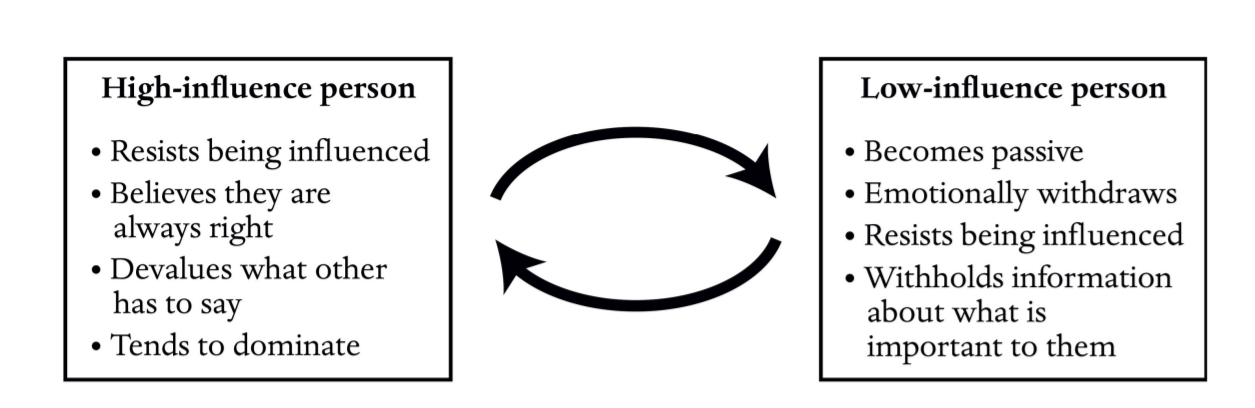
Influence discrepancies exist in most relationships, though minor ones are rarely a barrier to talking honestly and coming to an effective solution.
However, a significant difference in influence often results in a dysfunctional cycle.
How you give away influence
- Assuming that your needs are secondary to the other’s
- Not listening to your feeling
- Letting yourself be interrupted
- Backing down when someone disagrees with you
- Avoiding conflict—not disagreeing with the other
- Not giving feedback, assuming the problem is probably yours
- Being concerned about being liked/approved of and seeing that as most important
- Minimizing the importance of your comments
- Not taking credit for your accomplishments
- Not pointing out a problem unless you have a solution.
The single most limiting one is the fear of conflict—believing that conflict is a sign of a flawed relationship.
All feedback is data
The information may say something about the giver, and it may say something about the receiver. But it is all data, and more data is better than less. Quite simply, you’re better off knowing than not.
Accepting the validity of someone’s feedback also doesn’t mean you must act on it. Feedback is information for you to decide what to do with. It’s data with which to expand your choices.
The feedback sandwich is flawed
People use the “feedback sandwich,” thinking it will make difficult feedback easier to hear: starting with something positive (to soften up the other person), then saying something negative, and ending with something positive so they will feel good.
Unfortunately, this approach rarely works. As soon as you start with the positive, the other’s defenses go up as they wait for the “but.” They brush aside the good news and don’t take it in. The feedback sandwich is often utilized because you’re concerned the recipient will feel totally rejected if you don’t throw in some positive reinforcement.