The Emotion Wheel: Purpose, Definition, and Uses
Curated from: www.berkeleywellbeing.com
Ideas, facts & insights covering these topics:
20 ideas · 7.7K reads
What is the Emotion Wheel?
The Emotion Wheel was created by Robert Plutchik to help organize complex emotions and so that people could more easily gain clarity, identify, and label their emotions. We'll dive into the specific emotions in the emotion wheel, and how to use it, but first let's talk a bit about what an emotion is.
What is an Emotion?
Emotions prepare us to respond to a perceived or real environmental stimulus (e.g., being chased by a mountain lion or thinking that a friend is angry can both produce fear, causing us to retreat). But what differentiates an emotion from a mood, a physical state, or a thought? Emotions differ from moods in that they typically last minutes to seconds, whereas moods can last hours to days. Emotions also produce a set of coordinated responses (more on this below).
Theories Behind the Emotion Wheel
Emotions have been of interest to philosophers and scientists for centuries. Currently, there are 2 primary theories about emotion.
The evolutionary theory of emotion states that emotions evolved to enhance survival by prompting appropriate reactions to the environment (e.g., like being chased by a bear). While humans generally do not have the same threats to their survival as our primal ancestors, emotions still serve important social functions by communicating intentions and future actions.
The Evolutionary Theory: Emotions Are Innate
According to the evolutionary theory of emotion, emotions are thought to have clear neural bases in the brain and are universal across cultures and species. As such, emotions are thought to be innate. Plutchik's emotion wheel uses an evolutionary perspective on emotion.
Theories Behind the Emotion Wheel
The social constructivist theory of emotion (Barrett, 2009) posits that emotions are not innate, and instead are socially and culturally constructed. In other words, past experience, informed by upbringing and culture, colors our interpretation of visceral experiences and labels them as emotions.
The Social Constructivist Theory: Emotions Are Developed
For example, not all cultures have the same words for different emotions (the German word ‘schadenfreude’ means taking pleasure in someone else’s pain and there is no equivalent word in the English language). This view of emotions suggests that multiple brain networks work in tandem during emotional responses (rather than there being specific neural bases for individual, discrete emotions).
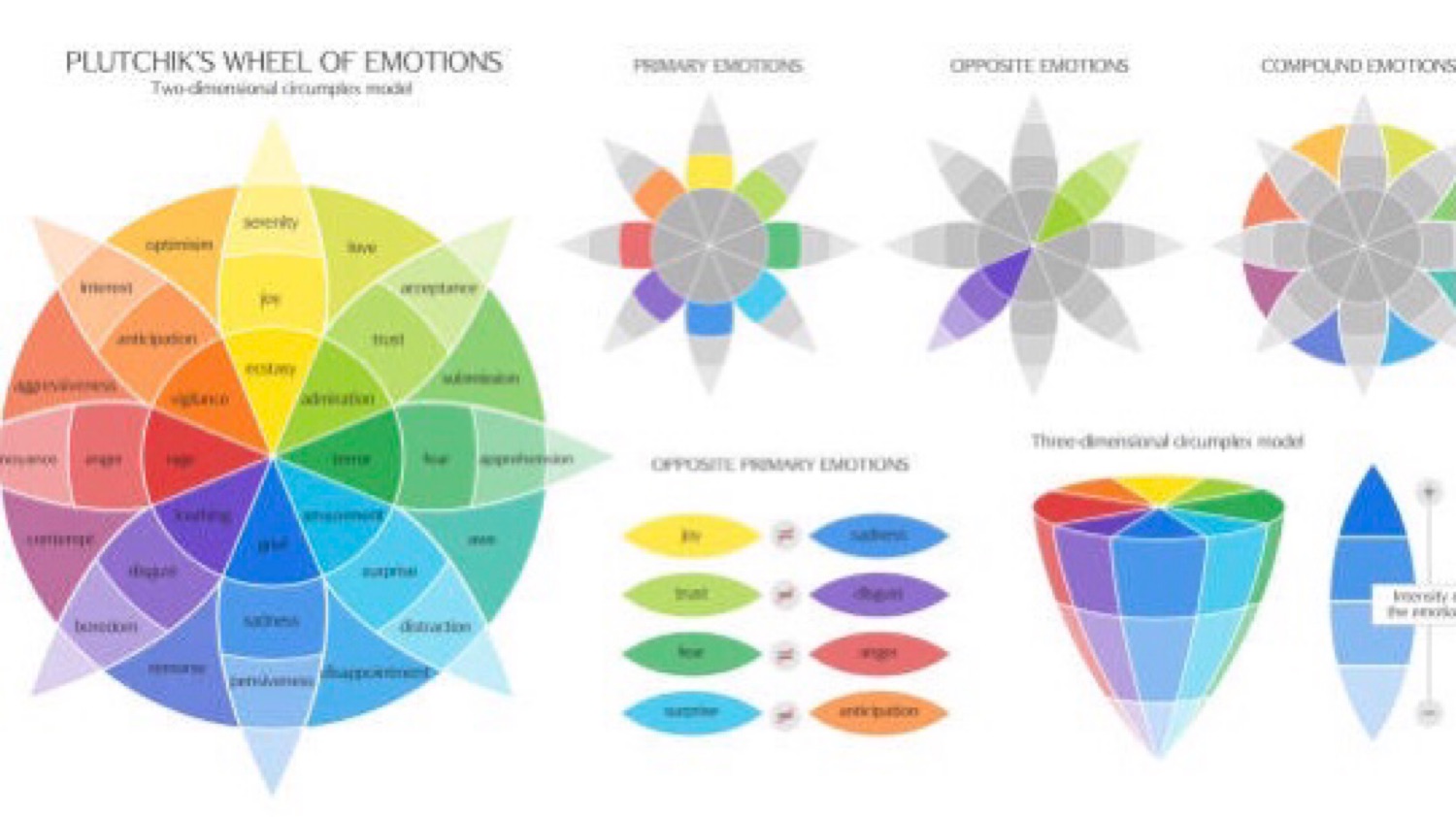
The Emotion Wheel
Given the complexity of emotions, Robert Plutchik created the Emotion Wheel to visualize the complexity of emotions and help people identify and label their emotions. The Emotion Wheel uses color to depict discrete emotions and blends of emotion, uses their gradients to express intensity, and uses the geometric shape to reflect polarity (or similarity) of emotions.
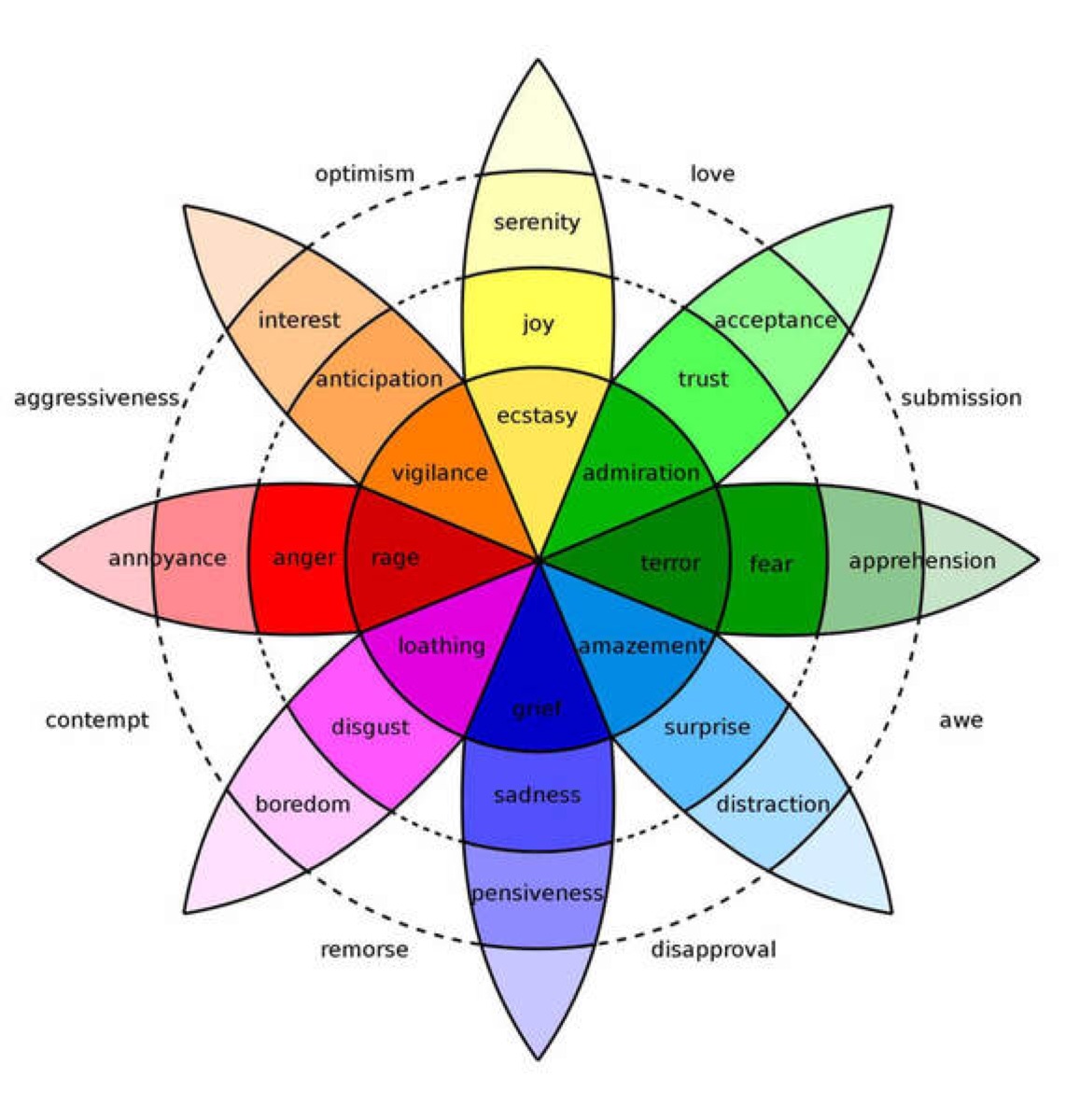

Relationships Between Emotions
The center of the emotion wheel reflects the maximal levels of arousal of each emotion. The emotions further away from the center of the emotion wheel represent milder arousal levels of the primary emotions. Emotions placed closer to each other in the emotion wheel are deemed more similar than those farther apart. The words outside of the ‘slices’ in the emotion wheel are common blends of emotion (e.g., ‘surprise’ and ‘sadness’ combine to produce ‘disapproval’).
The Components of Emotion in the Emotion Wheel -1 Of 3
Emotions are coordinated with the body’s physiological responses.
For example, when you are scared, your heart rate typically increases and your palms get sweaty. There is some debate about whether emotions precede or proceed these physiological responses (James, 1884). Either way, there is ample empirical evidence that suggests that physiological responses accompany emotions.
The Components of Emotion in the Emotion Wheel -2 Of 3
Emotions are associated with facial, verbal, and/or behavioral expressions.
Charles Darwin first noted the universality of this component of emotion in his book, “On the Expression of Emotion in Man and Animals” published in 1872. For example, he wrote about how the fear expression (e.g., raised hairs or goosebumps) can be seen in cats and other animals (including humans).
The Components of Emotion in the Emotion Wheel -3 Of 3
The subjective feeling component of emotion refers to our experience of emotions.
When we talk about our emotions, the subjective feeling is typically what we think of and describe (e.g., “I feel sad about…”). Writing about emotions or using a rating scale to rate your emotions tap into this subjective component.
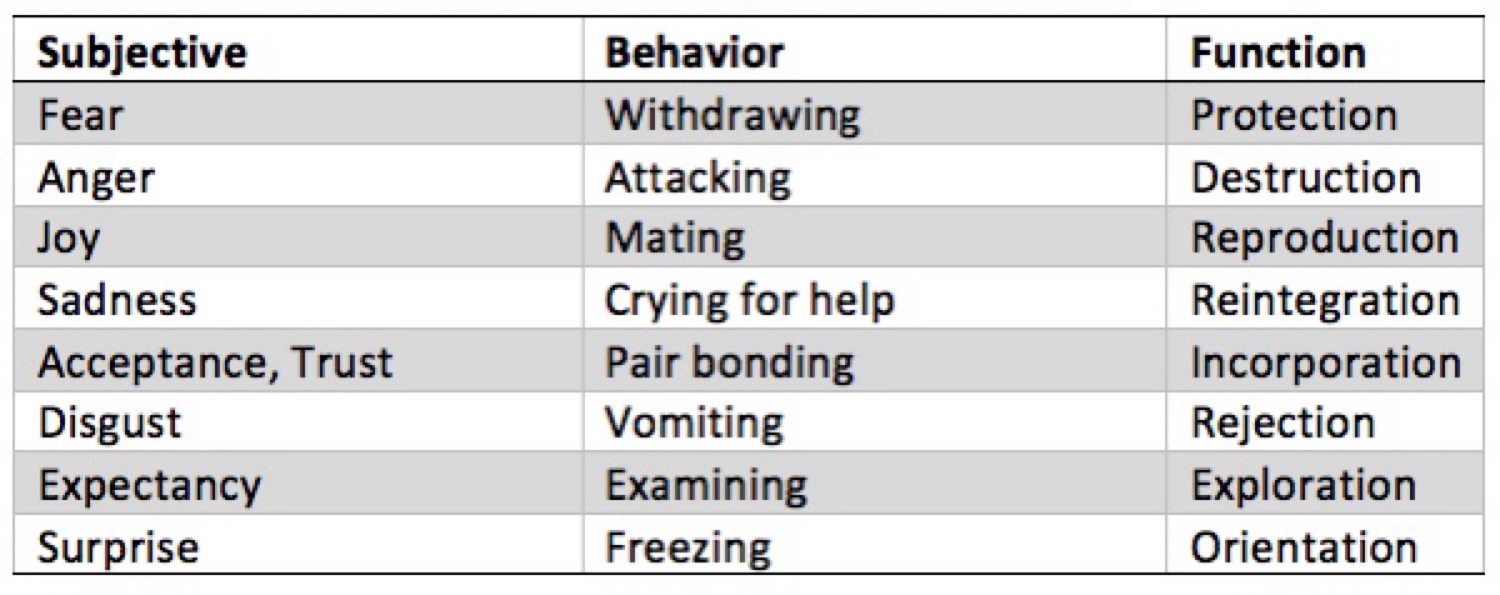
The Functions of Emotions in the Emotion Wheel
Plutchik argued that each emotion serves an evolutionary function and he identified specific survival behaviors as triggered by specific emotions.
For example, the emotions of fear/terror result in withdrawing behaviors that are meant to protect oneself. In our ancestors, fear or terror may have been caused by seeing a wild animal and running away in order to preserve their life. In current times, fear or terror can result from psychological threats of rejection, which can lead some people to run away in order to keep themselves from getting hurt.
How to Use the Emotion Wheel
The Emotion Wheel can be a useful tool in individual therapy, group settings, or on your own to identify, generate, and explore the complexity of emotions. For example, in therapy, the Emotion Wheel can be a visual cue to discuss and label one’s emotions or try to generate an emotion that has been suppressed.
How to Use the Emotion Wheel
The Emotion Wheel can also be used to reflect on some of the bridges people experience between their emotions (e.g., anger and sadness may frequently co-occur). To help people regulate their emotions, the Emotion Wheel can be a visual aid for converting emotions from negative to positive (like going from sadness to serenity). Understanding the underlying functions of each emotion can also help people discuss the root causes of their feelings.
Why Does the Emotion Wheel Work?
People at times struggle with communicating how they feel. People often say they “feel bad” and sometimes cannot be more specific. Using clear emotion labels helps people to have more awareness of their emotions and communicate with others about their needs. People who use more granular language to describe their emotions tend to be more psychologically healthy and resilient. The Emotion Wheel allows people to do this more easily by using colors, shapes, and symbols, and, like art, it can help people dig deeper into their emotions, their complexity, and their meaning.
Using the Emotion Wheel to Boost Well-Being
Now that you have the emotion wheel to better identify and label your emotions, here are some exercises that can help you put this tool to use to grow your well-being.
- Explore what emotions you value
- Explore what contributes to your happiness
- Learn to pay attention to the positive

All perception is colored by emotion.
Human behavior flows from three main sources: desire, emotion, and knowledge.

Emotions can get in the way or can get you on the way.