
Before Walt Disney: 5 Pioneers of Early Animation
 Curated from:
www.theatlantic.com
Curated from:
www.theatlantic.com
Ideas, facts & insights covering these topics:
5 ideas · 124 reads

The Story of Fantasmagorie (1908)
Émile Cohl is the father of the animated cartoon. In 1907, Cohl was hired as a scenarist by Gaumont to generate one-page story ideas for movies.
Between February and May 1908, Cohl created Fantasmagorie, the first fully animated film. To create the animation, Cohl placed each drawing on an illuminated glass plate and traced the next drawing, reflecting the variations needed to show movement. The animation contained over 700 illustrations.

Georges Méliès (The Prolific Egg)
Georges Méliès was the first cinemagician for his early use of special effects in cinema.
In 1902, he appeared in one of his own films, l'oeuf du sorcier (The Prolific Egg). The groundbreaking exploration of scale, multiplication, and transitions truly sealed his reputation as a "cinemagician".

Winsor McCay (Little Nemo)
McCay is considered the father of "true" animation.
His 1911 film, Winsor McCay, the Famous Cartoonist of the N.Y. Herald and His Moving Comics, or Little Nemo contains two minutes of pure animation using sequential hand illustration in a novel way.
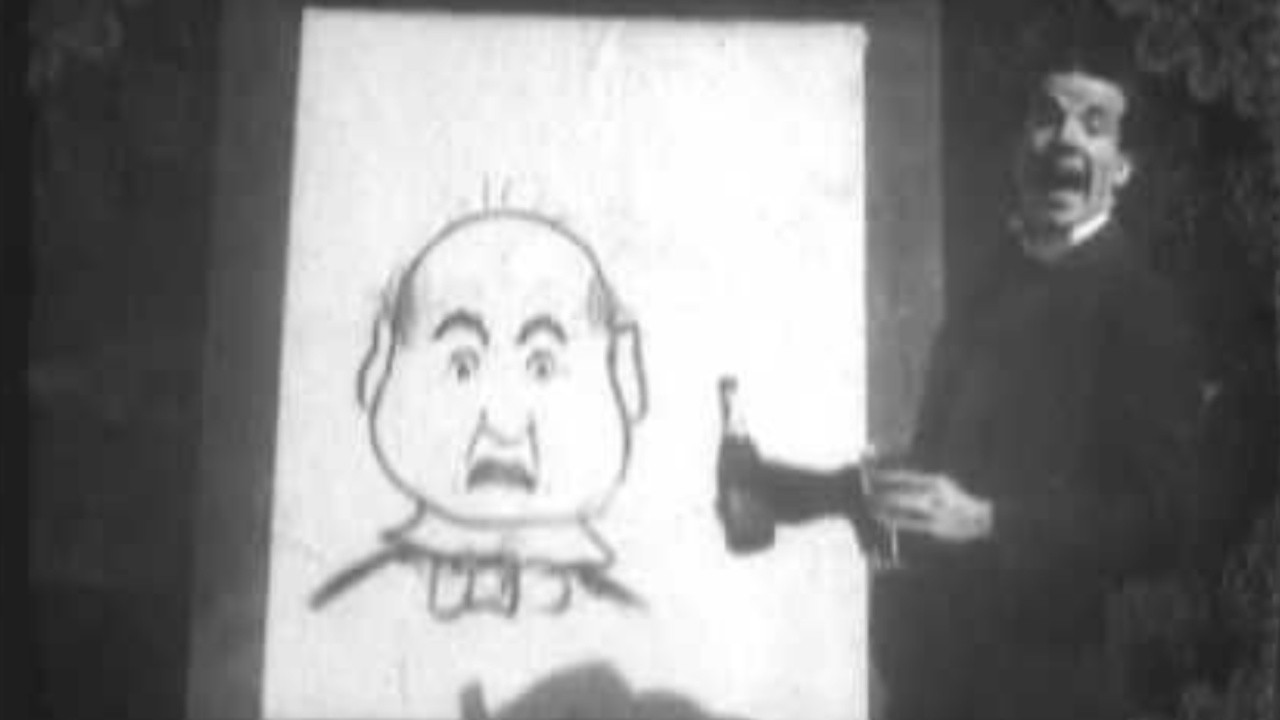
The Enchanted Drawing (1900)
British filmmaker J. Stuart Blackton is credited with creating the first animation in America. He was the first to use stop-motion as a storytelling technique.
In The Enchanted Drawing, Blackton sketches a face, cigars, and a bottle of wine, then "removes" these last drawings as real objects so that the face appears to react.

Muybridge: Waltzing couple (1893)
The animal locomotion studies of Eadweard J. Muybridge are among the earliest visual experiments in creating an illusion of motion. The "persistence of vision" principle laid the foundation for later forms of videography.