This is the difference between equity and equality
Curated from: www.fastcompany.com
Ideas, facts & insights covering these topics:
7 ideas · 536 reads

Everyone Is Different: The Background
Equity is absolutely not the same as equality, but they play for the same team. Equitable solutions require us to understand history, context, and cultural relativism.
Much of the historical narrative and cultural consensus has focused on the struggle for equality: equal rights, equal treatment, and equal opportunity. It was only half a century ago that the principles of our Constitution were finally written into laws that granted all people the same treatment before the law—regardless of “race, colour, sex, or national origin,” as the Civil Rights era formula goes.
Understanding Equity And Equality: The Pic On The Left
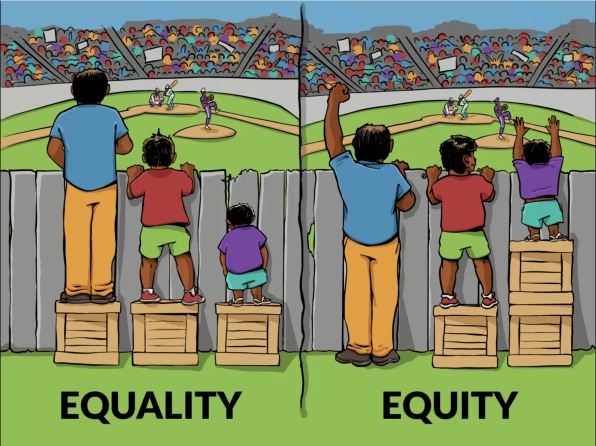
You can immediately appreciate the difference between the 3 people in the picture, who are the same on each side: a grown man, a child, and a toddler. Each of them wants to see the baseball game, but two of them are not tall enough to see over the fence.
The image on the left shows what happens in an “equal” society, when everyone is given the same advantages, treatment, rights, and resources (at least, to the best ability of that society’s government).
Providing More People With Access And Inclusion: The Pic On The Right
Giving everyone the same treatment is not the same as giving every individual the treatment they need. So with “equal” resources, one kid can just see over the fence and the toddler can’t at all. The conclusion: equal treatment is not necessarily sufficient to ensure everyone has a shot at truly thriving in society.
When we tailor the division or allocation of resources to individuals and their different needs, we’re able to give more of them access and inclusion. The kids can now see what’s happening over the fence (access) and are sharing in the experience with the grown-up (inclusion)

Equality Is the Bare Minimum
In the United States, in particular, much of the historical narrative and cultural consensus has focused on the struggle for equality: equal rights, equal treatment, and equal opportunity.
There was nothing stopping individuals, businesses, or the government from discriminating against people of colour in the fields of employment, education, housing, and politics.
On paper, that all changed in the 1960s. The Fair Housing Act of 1968 made it illegal to discriminate against anyone in the sale, rental, or financing of housing on the basis of race, religion, sex, or national origin.

- Red-lining patterns from the 1930s to designate which neighbourhoods were “uninsurable” for housing loans still exist in many poor, majority-Black neighbourhoods.
- The wage gap between white and Black men is effectively the same as it was in the 1950s, when you adjust for the numbers of Black men who are currently incarcerated
- Black women are paid 58 cents for every dollar white men make and 21% less than white women

When Equality Alone Doesn't Lead to Better Outcomes
- In education, many educational institutions have tried to take an equitable approach into their own hands by ensuring their student bodies are more diverse.
- Affirmative action is an early form of equity, in which the powers that be acknowledge that not all employees faced the same treatment by their employers.
- The idea is to promote diversity by using race as a factor in making decisions about the overall composition of the student body.

Equitable Solutions Are Unequal and That's the Point
- Equality doesn't magically lead to better outcomes
- Equal measures require understanding history, context, and cultural relativism
- They also ask us to consider individuals as just that: individual human beings with specific needs and backgrounds
- In theory, equitable solutions and practices have to change as time, society, and the numbers change