 Curated from:
What Is Exactly The Butterfly Effect
The butterfly effect rests on the notion that the world is deeply interconnected, such that one small occurrence can influence a much larger complex system.
The effect is named after an allegory for chaos theory; it evokes the idea that a small butterfly flapping its wings could, hypothetically, cause a typhoon.

Example
Imagine you bumped into someone at a coffee shop that happens to work at your dream company and eventually got you an interview there.
What if you had chosen a different coffee shop, or been there five minutes later? You may not have met the person that got you into your dream job. The idea that something small, like getting coffee, can have much larger effects, such as altering your career is called the butterfly effect.

“You could not remove a single grain of sand from its place without thereby … changing something throughout all parts of the immeasurable whole.”

However
Of course, a single act like the butterfly flapping its wings cannot cause a typhoon.
Small events can, however, serve as catalysts that act on starting conditions.

"Some systems … are very sensitive to their starting conditions, so that a tiny difference in the initial ‘push’ you give them causes a big difference in where they end up, and there is feedback, so that what a system does affects its own behavior.”
Edward Lorenz and the Discovery of the Butterfly Effect
In an experiment to model a weather prediction, Edward Lorenz ( a meteorologist and a mathematician) entered the initial condition as 0.506, instead of 0.506127.
The result was surprising: a somewhat different prediction. From this, he deduced that the weather must turn on a dime. A tiny change in the initial conditions had enormous long-term implications.

Tiny Changes Can Throw Off Results
He theorized that weather prediction models are inaccurate because knowing the precise starting conditions is impossible, and a tiny change can throw off the result. To make the concept understandable to non-scientific audiences, Lorenz began to use the butterfly analogy.
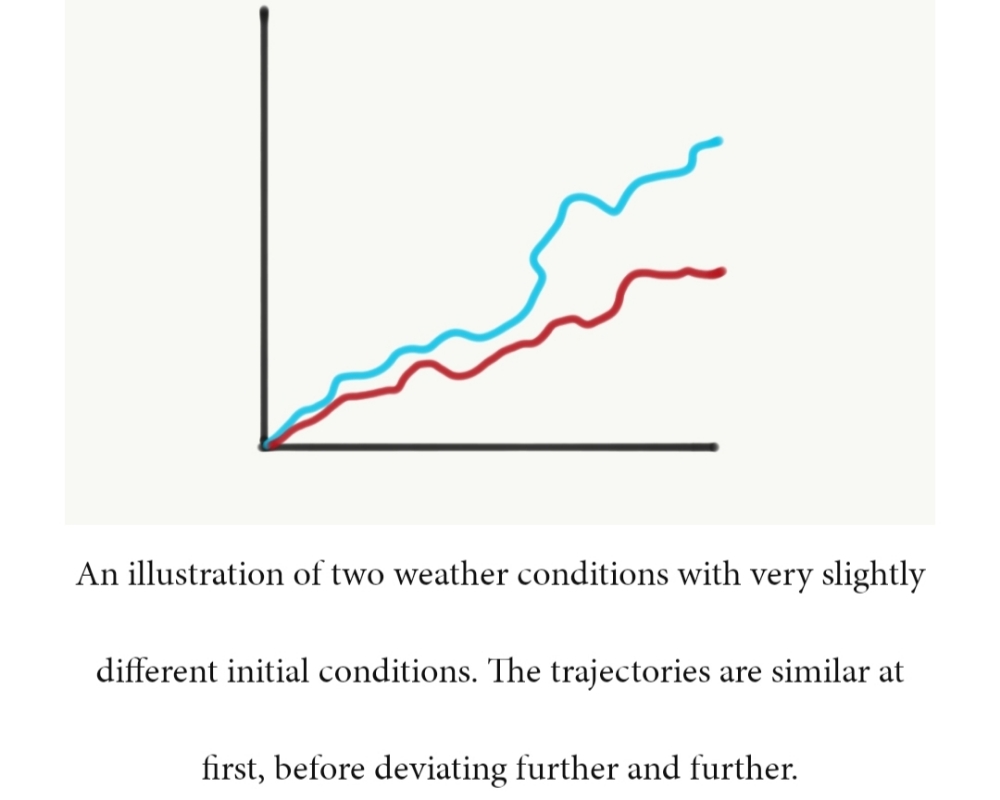
It is symbolic representation of an unknowable quantity
he butterfly effect is somewhat humbling—a model that exposes the flaws in other models. It shows science to be less accurate than we assume, as we have no means of making accurate predictions due to the exponential growth of errors.