Braving The Wilderness Summary
 Curated from:
fourminutebooks.com
Curated from:
fourminutebooks.com
Ideas, facts & insights covering these topics:
20 ideas · 3.5K reads
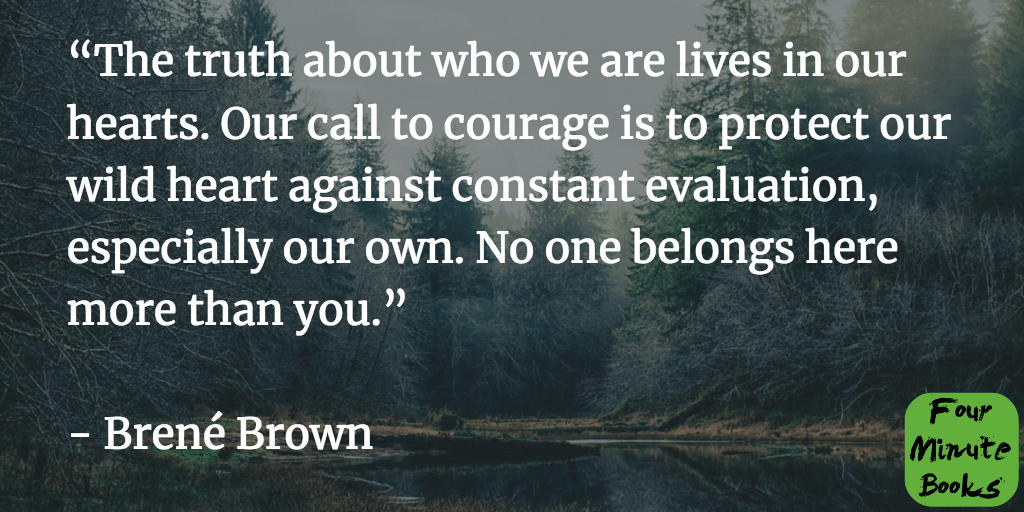
Author Quote
"The truth about who we are lives in our hearts. Our call to courage is to protect our wild heart against constant evaluation, especially our own. No one belongs here more than you."
-Brene Brown
Bracing The Wilderness - Book Summary (Finding Authenticity)
Braving The Wilderness offers a four-step process to find true belonging through authenticity, bravery, trust, and vulnerability since it’s mostly about learning to stand alone rather than trying to fit in.
Book Overview
On Maslow’s hierarchy of human needs , belonging is the first thing we desire right after ensuring our own physical survival. And while it’s a very common word, it’s actually hard to describe, isn’t it? It feels kind of fuzzy as if we all mean something different, but we all know it when we feel it.
In Braving The Wilderness , bestselling author Brené Brown is looking to clear up some of that confusion. What’s more, by sharing her own story of how she chased this fundamental need for decades to no avail, she teaches us how to avoid common pitfalls on our way to find it. To her, belonging is mostly about learning to belong to ourselves.
But to do that, we need not just the right groups of people, but also the courage to stand alone and be ourselves when no one wants to have our back.
Top 3 Book L
- Once you stop working so hard on fitting in, you’ll find it’s easier to allow yourself to be you.
- The courage you need to be who you are comes from learning to trust yourself and others.
- Don’t swallow your anger, but turn it into a positive before it becomes resentment.
Brown’s metaphorical wilderness is the unkown, the scary, the life outside our comfort zone. It’s time to understand and engage it!
Lesson 1: Be Yourself - Stop Trying To Fit In
All of us experience rejection in one way or another early in our lives. For Brené , it was not getting picked for the cheerleading team and her parents’ subsequent disappointment. For me, it was being sneered at for being smart and wearing glasses. That sucks, but real problems only follow if we then spend the rest of our lives trying to make up for these early traumas .
Eventually, you’ll hate yourself not for not fitting in, but for trying so hard to do and failing. That’s a good sign it’s time to stop. For Brené, this sign came in the form of Steve, who she would later marry. When she met him in the 80s, she was on a full-on drinking, partying, and smoking spiral, desperately trying to belong.
Steve encouraged her to learn to be herself. Brené started by writing herself permission slips , like “you’re allowed to be goofy, have fun, and enjoy life,” which was her first one. The more of those she wrote, the less reliant she became on other people’s opinions. Now, she wears any attire to her speaking gigs , no matter the dress code.
Ultimately, belonging is about feeling good in your own skin above all else.
Lesson 2: Courage omes From Trusting Both Others And Yourself
Throwing the expectations of others to the winds is liberating, but it takes courage. This courage to face the world on your own will partly come from building trust . Trust in other people, trust from other people, and, most of all, trust in yourself.
7 Traits That Make You Trustworthy
- Be reliable . When you make a promise , value it. Honor it. Those you make to others, but especially those you make to yourself.
- Own your mistakes . Being wrong isn’t a character flaw. But it can become one if you don’t own up to it. We hate admitting mistakes more than making them , but that’s exactly why it’s so important to learn.
- Respect boundaries . Most people will signal when you’re crossing a line. Try to stop then. Try to spot the signals.
- Protect secrets . If someone confides in you, treat that vote of confidence with respect. Don’t blab.
- Be reliable . When you make a promise , value it. Honor it. Those you make to others, but especially those you make to yourself.
- Own your mistakes . Being wrong isn’t a character flaw. But it can become one if you don’t own up to it. We hate admitting mistakes more than making them , but that’s exactly why it’s so important to learn.
- Respect boundaries . Most people will signal when you’re crossing a line. Try to stop then. Try to spot the signals.
- Protect secrets . If someone confides in you, treat that vote of confidence with respect. Don’t blab.
- Decide with integrity . When in doubt, just a
sk yourself what’s the right thing to do. Your gut will always know . Stop judging . This is hard, but you can practice it. We usually judge others based on their actions or their intentions. Try to replace this tendency with curiosity instead, and you’ll become more compassionate and kind. Be generous . Whatever you have more of than other people, share it with them. Whether it’s time, money, a certain skill, doesn’t matter. As long as you look out for those around you.
5. Decide with integrity . When in doubt, just ask yourself what’s the right thing to do. Your gut will always know .
6. Sop judging . This is hard, but you can practice it. We usually judge others based on their actions or their intentions. Try to replace this tendency with curiosity instead, and you’ll become more compassionate and kind.
7. Be generous . Whatever you have more of than other people, share it with them. Whether it’s time, money, a certain skill, doesn’t matter. As long as you look out for those around you.
- Be reliable . When you make a promise , value it. Honor it. Those you make to others, but especially those you make to yourself.
- Own your mistakes . Being wrong isn’t a character flaw. But it can become one if you don’t own up to it. We hate admitting mistakes more than making them , but that’s exactly why it’s so important to learn.
- Respect boundaries . Most people will signal when you’re crossing a line. Try to stop then. Try to spot the signals.
- Protect secrets . If someone confides in you, treat that vote of confidence with respect. Don’t blab.
- Decide with integrity . When in doubt, just a
sk yourself what’s the right thing to do. Your gut will always know . Stop judging . This is hard, but you can practice it. We usually judge others based on their actions or their intentions. Try to replace this tendency with curiosity instead, and you’ll become more compassionate and kind. Be generous . Whatever you have more of than other people, share it with them. Whether it’s time, money, a certain skill, doesn’t matter. As long as you look out for those around you.
You can do all of these in small ways, but if you repeat them thousands of times over months and years, eventually, a web of trust will form around you. And it’ll build confidence unlike any you’ve ever felt before.
Lesson 3: Use Your Anger To become Better, Not Bitter
In November 2015, a series of coordinated terrorist attacks led to the deaths of 130 people in Paris, France. One of the many victims was Hélène Leiris, whose husband Antoine and baby son Melvil were at home. If there’s a single good reason to be angry in this world, it’s losing someone you love before their time is up.
But instead of succumbing to his fury and grief, Antoine wrote a letter . He called it “You Will Not Have My Hate ” and posted it on Facebook. In it, he showed pity for the terrorists and announced to them that his and his son’s lives would go on. That they would always look forward and that their happiness would defy everything their acts stood for.
Antoine’s outpour of love following such deeds of pure hatred went viral and received support from all over the world. Eventually, he expanded the letter into a book and, today, he’s pushing for more political awareness of terrorism at the European level.
When you feel anger, acknowledge it. But don’t let it turn you into someone you’re not. Use it. Make positive change. Turn it into betterness, not bitterness.
Braving The Wilderness - Book Review
Brené ‘s books aren’t the most straightforward. They rarely give you a few steps and one, two, three, you’re done. They’re about processes of changes. They tell you stories that inspire. They’re honest, raw, and you have to pick out what works for you. But they never fail to make you feel like you’re on the right path. Braving The Wilderness is no exception.
Who would I recommend Braving The Wilderness to?
The 15 year old high school student who’s just learning to play our many social games, the 46 year old mother who’s scared to try something new, and anyone who knows their own anger is hurting them.