How to Leave your Comfort Zone and Enter your ‘Growth Zone’

Ideas, facts & insights covering these topics:
35 ideas · 65.6K reads

What Is the Comfort Zone in Psychology?
“The comfort zone is a behavioral state within which a person operates in an anxiety-neutral condition, using a limited set of behaviors to deliver a steady level of performance, usually without a sense of risk.” - Judith Bardwick in her 1991 work Danger in the Comfort Zone
- Within the comfort zone, there isn’t much incentive for people to reach new heights of performance.
- It’s here that people go about routines devoid of risk, causing their progress to plateau.

Link Between Anxiety and Performance
In 1907, Robert Yerkes and John Dodson conducted one of the first experiments that illuminated a link between anxiety and performance.
- They saw that mice became more motivated to complete mazes when given electric shocks of increasing intensity – but only up to a point.
- Above a certain threshold, they began to hide rather than perform.
Corresponding behavior has been seen in human beings.
- This makes sense because in response to anxiety-provoking stimuli, the options are either fight (meet the challenge), flight (run away/hide), or freeze (become paralyzed).

The Yerkes–Dodson Law (Yerkes & Dodson, 1907)
This is true not just for more tangible types of performance such as being given a stressful new task at work, but also in many life areas such as understanding ourselves, relating to others, and so on.
The core idea is that our nervous systems have a Goldilocks zone of arousal.
- Too little, and you remain in the comfort zone, where boredom sets in.
- But too much, and you enter the ‘panic’ zone, which also stalls progress.
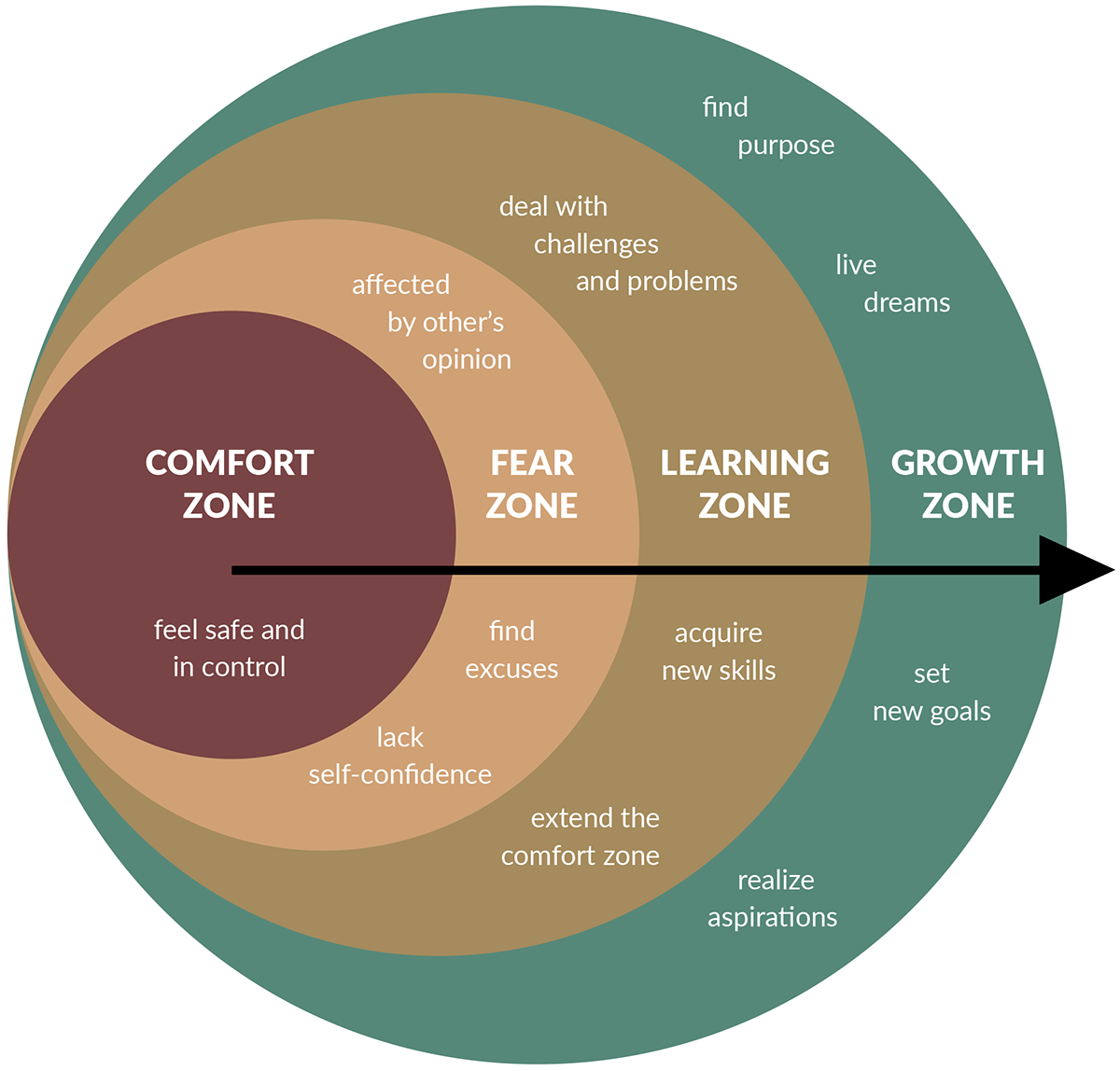
From Comfort Zone to the Growth Zone
When leaving the comfort zone, fear doesn’t always equate to being in the panic zone. As the above diagram shows, fear can be a necessary step en route to the learning and growth zones.

What does it mean to be in Growth Zone
- It takes courage to step from the comfort zone into the fear zone.
- Without a clear roadmap, there’s no way to build on previous experiences.
- This can be anxiety provoking. Yet persevere long enough, and you enter the learning zone, where you gain new skills and deal with challenges resourcefully.
- After a learning period, a new comfort zone is created, expanding one’s ability to reach even greater heights.
- This is what it means to be in the growth zone.

How big is your comfort zone?
- Across every life domain, everyone’s zones vary in size.
- To leave your comfort zone, you must appreciate its outer limits.
- Similarly, you must develop an intuitive sense of where your panic zone lies.
- Taking on challenges that lie somewhere in between will stretch you, leading to growth and learning.

What are your strengths?
- Understanding and capitalizing on personal strengths can be of great use.
- Most people have experience leaving the comfort zone in at least one area of life, and there are usually plenty of insights to be uncovered from this experience.

The process of moving from comfort zone to growth zone
- The process of moving from the comfort zone to a growth zone may not be linear.
- Peaks, troughs, and plateaus often complicate the journey.
- Sometimes, we even need to retreat to the comfort zone periodically before mustering the strength to leave again.
- Nevertheless, appreciating the steps can help in tolerating uncertainty.
- While occupying the comfort zone, it’s tempting to feel safe, in control, and that the environment is on an even keel. It’s smooth sailing.
- The best sailors, however, aren’t born in smooth waters.
1. Self-actualization
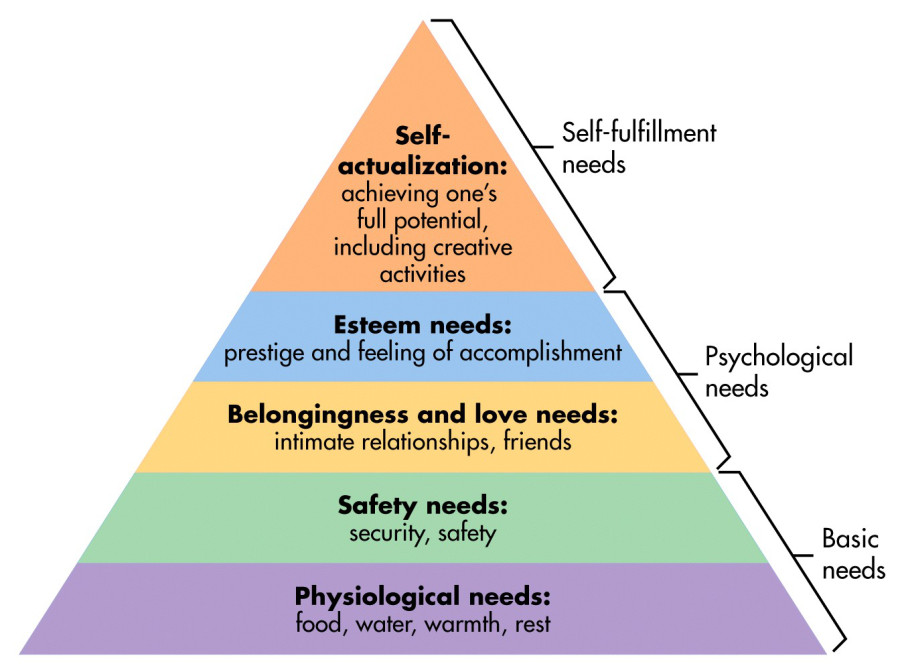
For many, self-actualization acts as a powerful incentive to leave the comfort zone.
Maslow’s hierarchy of needs operates like a ladder, with the satisfaction of our ‘basic’ and ‘psychological’ needs being analogous to inhabiting the comfort zone.
As long as the decision to leave the comfort zone aligns with a person’s values, this shift is akin to making a bid for self-actualization.
Why is this important? For one, not striving for growth could mean falling into a state of inertia later in life.

2. Development of a growth mindset
Stanford psychologist Carol Dweck’s (2008) work on mindsets marked a paradigm shift in the field of positive psychology.
- With a fixed mindset, people believe they have set doses of each ability, with a corresponding ceiling on how much they can achieve.
- The growth mindset means recognizing humans as malleable. From this stance, setbacks become opportunities for learning (Dweck, 1999) and our potential becomes unlimited.
- The growth mindset expands the possible. It inspires us to learn and take healthy risks, leading to positive outcomes across life domains.

3. Resilience and antifragility
A habit of expanding our comfort zone equips people to handle change and ambiguity with more poise, leading to resilience.
- Taking this further, statistician Nassim Taleb (2012) introduced the concept of ‘antifragile’ systems, which “thrive and grow when exposed to volatility, randomness, disorder, and stressors. ”
While resilient systems bounce back to the same level after a shock, antifragile systems learn to grow from them, reaching new heights.
- To step outside the comfort zone then is to purposefully cultivate antifragility – so long as we don’t veer into the panic zone.

4. Greater self-efficacy
As outlined by Albert Bandura (1997), self-efficacy is the belief in being able to execute necessary actions in service of a goal.
Goals that lead to higher self-efficacy are specific, not too difficult, and short-term (Yailagh, Lloyd, & Walsh, 2009).
Leaving the comfort zone means a phase of trial and error, during which at least some level of success is inevitable.
Experiencing this success builds our self-efficacy, with belief in our ability starting to grow.
The cumulative upward spiral of achievement and confidence can become a potent asset for anyone.

1. Reframe stress
Physiologically, there’s no difference between anxiety and excitement (Smith, Bradley, & Lang, 2005).
Both entail a ‘stress response,’ but whether they’re perceived as positive or negative is a matter of labeling.
Society tends to conceptualize all stress as ‘bad,’ but the idea of ‘eustress’ or ‘positive stress’ challenges this.
Eustress provides the energy to get through a public speech, go on a romantic date, and so on. These stimuli can be reframed as exciting, propelling us out of the comfort zone.

2. Understand neuroplasticity
An essential step toward internalizing the growth mindset is to embrace neuroplasticity research. Once understood, less courage is needed to make the first move away from comfort because failure itself becomes integral to the journey.
At the core of Dweck’s theory is that humans are malleable and adaptable.

3. Prioritize
Occupying the comfort zone isn’t always detrimental. For example, it might be reasonable to stay in your ukulele-playing comfort zone but not your managing-personal-finances one.
The point is to identify bottlenecks: areas of life where being too comfortable does more harm than good. Encourage goal selectivity so you can focus effectively.

4. Small steps
It’s okay to take small, methodical steps, as well as larger, bolder ones.
Leaving behind the comfort zone doesn’t mean recklessly throwing caution to the wind. Every step forward is progress.
Patiently fostering self-awareness while intelligently assessing each zone’s boundaries is a sure way to make the process as smooth as possible.

1. Do everyday things differently.
In everyday life, there are ample opportunities to challenge yourself.
- Turn off your smartphone and television while having dinner, decide what to wear more quickly, or just slow down to take in the surroundings on a walk.
- These changes break you out of old, comfortable routines.

2. Expand your professional skillset.
Growing your skillset can foster creativity and refresh your self-confidence, as well as increase employability.
Skills like public speaking, negotiation, and leadership can represent a new challenge for many people.
Investing in them can build resilience, personal satisfaction, and open up more opportunities than ever.

3. Try a new diet.
Many people want to improve their diets and stop relying on ‘comfort foods.’ Doing so often means trying something new.
Sticking to a healthy diet can be as challenging as it is rewarding, with self-efficacy growing as you hit milestone goals along the way.

4. Take workouts to the next level.
Similarly, many aspire to this goal. For some, it can mean running their first 5K, but for others, it might be completing a triathlon.
Aiming high with exercise is emblematic of leaving the comfort zone and a great way to get the ball rolling.

5. Get creative.
Creativity – anything from writing a poem to building a business – usually involves an element of risk.
Creative endeavors are about stepping into the unknown, with failing and subsequent learning as expected outcomes.
Exercising creativity is a good way to train yourself to have a growth mindset and let go of a need for perfection from the outset.

6. Challenge your beliefs.
While exploring alternative perspectives can be uncomfortable, it enables growth and insight by challenging entrenched beliefs.
This might take several forms, such as reading varied book genres, diversifying who you talk to, and visiting new places.
It’s easy to get stuck in our ways, but this can lead to complacency – a hallmark of being in the comfort zone.

7. Practice honesty.
When employed sensitively, honesty can be a tremendous catalyst for personal growth.
Whether being straight with yourself in a private journal or telling someone close how you feel, honesty forces people out of their comfort zone.
Through honest communication, we can understand ourselves better and build deeper bonds with others.

All growth starts at the end of your comfort zone.
You can only grow if you are willing to feel awkward and uncomfortable when you try something new.
My comfort zone is like a little bubble around me, and I’ve pushed it in different directions and made it bigger and bigger until these objectives that seemed totally crazy eventually fall within the realm of the possible.
Do one thing every day that scares you.
Becoming is better than being. The fixed mindset does not allow people the luxury of becoming. They have to already be.
One can choose to go back toward safety or forward toward growth. Growth must be chosen again and again; fear must be overcome again and again.
Without continual growth and progress, such words as improvement, achievement, and success have no meaning.
You have calibrated life when most of what you fear has the titillating prospect of adventure.
The level of effort you tolerate from yourself will define your life.
May your choices reflect your hopes, not your fears.

A Take-Home Message
- It’s crucial to cultivate a mindset that lays strong foundations, paving the way toward the growth zone.
- This includes seeing yourself as inherently adaptable, reframing stress, and believing in your ability to endure fears and doubts.
- You can settle for what you know – the seemingly safe, familiar, and routine.
- Or, you can become receptive to opportunities for growth, challenging your personal status quo and seeing what you’re capable of.
- When this becomes a habit, we reach our highest human potential, acting as an inspiration to others.