10 of the most bizarre elections in American history
Curated from: edition.cnn.com
Ideas, facts & insights covering these topics:
10 ideas · 968 reads
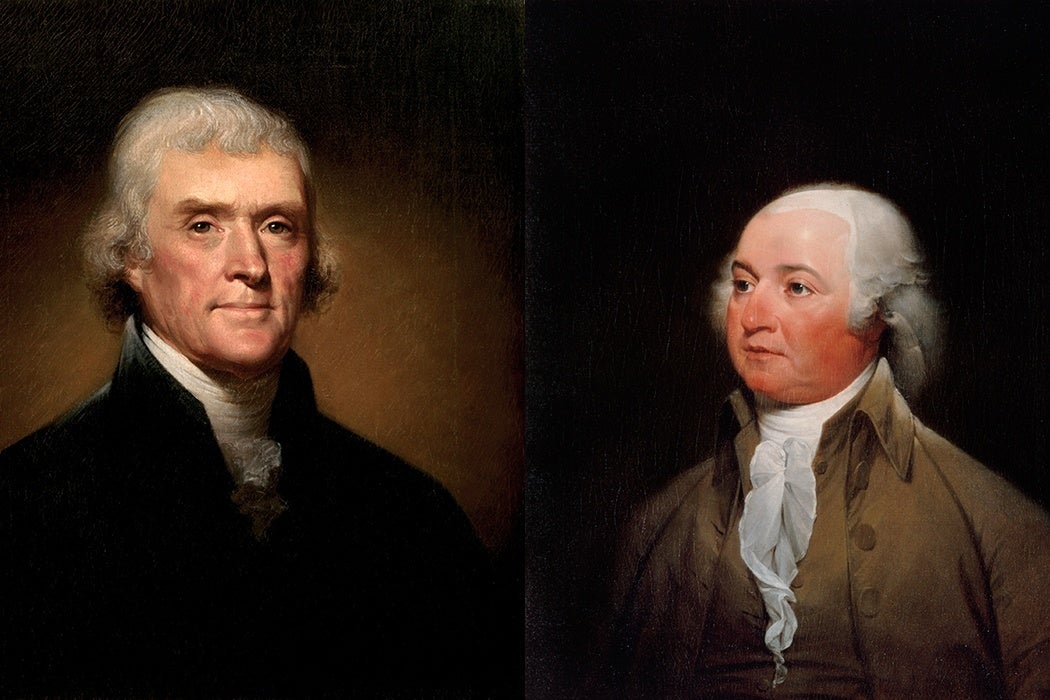
1800: Jefferson and Adams
The outcome was so bizarre, the United States had to amend the Constitution.
- The election of 1800 saw Thomas Jefferson tie with his Democratic-Republican "running mate" Aaron Burr. Both had 73 votes to Adams' 65.
- Alexander Hamilton, the nation's first treasury secretary and founder of the Federalist Party, started a campaign to convince the Federalists to vote for Jefferson the lesser of the three evils.
- After casting 35 ballots in a week, the House of Representatives finally voted to name Jefferson the victor. However, the rivalry between Burr and Hamilton continued for three years before Burr killed Hamilton in a duel.
1824: 'Corrupt bargain'
- Andrew Jackson won the popular vote by less than 39,000 ballots and took 99 Electoral College votes. John Quincy Adams secured 84, William Crawford won 41, and Henry Clay had 37.
- Clay, with the least votes, got the boot, and his supporters shifted their support to Adams, who would go on to win the majority of the House vote.
After his inauguration, Adams selected Clay as his secretary of state. Jackson accused Adams and Clay of a "corrupt bargain."
1860: Nation divided
The 1860 election was notable because it ripped the long-dominant Party (and nation) in half.
- The Democrats were unable at their 1860 convention to establish an official party line on slavery.
- At a second convention that year, the Democrats nominated Stephen Douglas, but many Southerners in the party selected Breckinridge as their man. Both would claim to be the official Democratic candidate.
- Lincoln snared 40% of the popular vote but took most of the North in the Electoral College.
- Douglas was second in the popular vote but took only Missouri.
- Breckenridge took most of the South.
- Bell's middle of the road policies earned him the middle of the road.
In 1861, delegates from South Carolina, and six of the Southern states formed the Confederate States of America and selected Jefferson Davis as their president.
1872: Death of a candidate
1872 was strange because one of the primary candidates never saw the final Electoral College vote.
- Ulysses S. Grant, who led the Union armies that defeated the Confederacy, had not been so convincing in the Oval Office.
- Some Republicans defected, becoming Liberal Republicans and cast their lot with Horace Greeley, a Democrat who got 44% of the popular vote.
- Before the Electoral College could cast its votes, Horace Greeley died. Grant attended his funeral.
1876: Not-so-independent tiebreaker
- Democrat Samuel Tilden had beaten Republican Rutherford Hayes.
- But Tilden was one Electoral College vote away from a majority of 185 votes, and four states composing a total of 20 votes, were disputing the results.
- The two parties agreed to establish a 15-member commission, comprising of seven Republicans, seven Democrats, and an independent.
- The independent was unexpectedly replaced by a diehard Republican who would cast every vote for Hayes, providing him the 20 votes he needed for a majority.
- Hayes was sworn in on March 5, 1877.

1920: Campaigning from prison
This election wasn't very exciting. Republican Warren G. Harding took more than 60% of the popular vote over Democrat James Cox, along with 37 of the 48 states.
Third place is interesting because union leader Eugene Debs ran his fifth campaign from prison. He was convicted under an espionage law and sentenced to 10 years in prison. Demonstrations protesting his imprisonment evolved into the May Day riots of 1919.

1948: Truman's "defeat"
- President Harry S. Truman was done before the election began. An opinion poll showed that only a third of Americans approved of Truman's handling of the presidency. The election was New York Gov. Thomas Dewey's.
- The final pre-election Gallup poll showed Dewey beating Truman by 5 percentage points. Publisher J.Loy Maloney took the pollsters' word and signed off on the headline "Dewey defeats Truman."
- Even on election day, an NBC report predicted Truman would lose. It wasn't until 4 a.m. that his Secret Service agents woke him to say he had won.
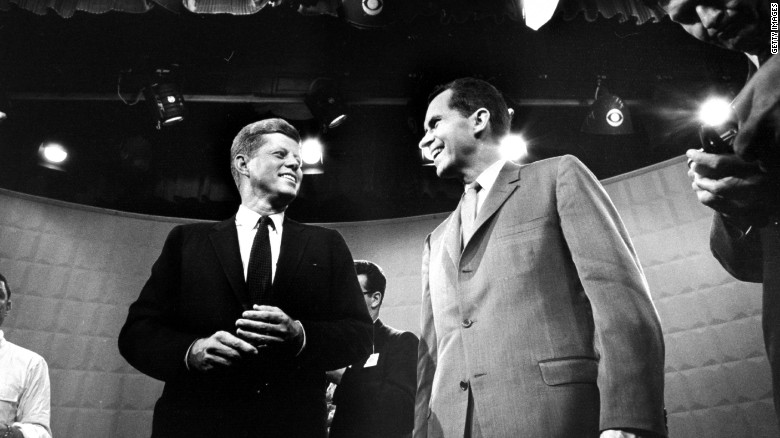
1960: Beginning of televised debates
The contest between John F. Kennedy and Richard Nixon marked another precedent: the first time that presidential debates were televised.
- Nixon had recently been hospitalized. He refused to wear makeup, giving him a thin, sickly appearance. He wore a gray suit that made him blend into the background.
- Kennedy was tanned and wore a blue suit and shirt, which made him stand out against the studio backdrop. He spoke to the cameras rather than to his opponent.
- Those who watched the debates on TV felt Kennedy won, while the audience listening on the radio felt Nixon was the victor.
- On November 8, Kennedy edged out Nixon by 199,000 votes.
1964: Mandate on race
This election was not about whether Republican Barry Goldwater or President Lyndon Johnson was a more capable commander in chief. Race shaped the 1964's ballot and would affect elections for decades to come.
- Goldwater, who had cast his vote against the Civil Rights Act, was painted as a racist. Johnson tried to please everyone.
- Johnson won one of the most lopsided elections ever. Goldwater won only his home state of Arizona and Alabama, Georgia, Louisiana, Mississippi, and South Carolina.
1972: Electroshock therapy
- Sen. George McGovern of South Dakota had just won the Democratic nomination for president and phoned Sen. Thomas Eagleton and asked him to be his running mate.
- Eagleton was quiet about his three hospitalizations for depression and his electroshock therapy on two of those occasions. He revealed his medical history during a news conference explaining that he had only recently divulged the matter to McGovern. Eagleton officially dropped out of the campaign 18 days after he was selected.
- Richard Nixon won, carrying 49 states and 18 million votes.