Libraries
Curated from: fivebooks.com
Ideas, facts & insights covering these topics:
17 ideas · 8 reads
Knowledge is Power
Knowledge is power and nowhere has it been better preserved down the millennia than in libraries. Here Richard Ovenden, author of "Burning the Books" and the librarian in charge of Oxford University's Bodleian Libraries, talks us through books that shed light on what libraries are and what they do, and why they remain absolutely vital in our digital age.
The Interview
What is a library? I say that it’s an organized body of knowledge. You can also have other organized bodies of knowledge, like archives, which are different to libraries, or indeed, things like Wikipedia. But libraries are accumulations of texts or other material or documentary evidence of some kind, either textual, visual, or indeed audio, that is in physical or in digital form, and which have been purposefully acquired in order to provide information or knowledge resources on a particular subject or approach which is normally defined by some kind of policy.
There are two sorts of people who are vital to this, it seems. First of all, there are the librarians. Secondly, the community of scholars around the library.
Yes, as Ranganathan says in his
“The Five Laws of Library Science”,Could you just say a little bit as well about your role as Bodley’s Librarian, because it’s an amazing position to be in?
I’m director of a research library, but it is more like a research library system. The Bodleian Library in Oxford, the historic institution, which I’m the 25th person to be responsible for, is a collection of books, formed partly through gift, partly through legal deposit, and partly through purchase. “It’s not this safe and cozy world that popular fiction might portray, it’s a dangerous game to be in” It’s also an institution to which other libraries have been attached.
In the 20th century, that was through a process of affiliation. There are now 29 libraries that are integrated with the Bodleian, which I’m responsible for. Then there are about 60 other libraries in Oxford, that are coordinated—that’s perhaps the best way to describe it—by the Bodleian in some way. So, they use the same online catalogue system that we provide and maintain and add their records to it. You can search across 90-odd libraries to find books, which may be digital materials that may be collected by any of them. It saves you the effort of doing that.
The Bodleian is an amazing library, and within it are some incredible books. You’ve not only seen but touched and experienced the magic of engaging with some of these relics. Also, they’re not just relics in the sense of belonging to the past because they have contemporary resonance as well, people keep coming back to them and discovering new things.
That’s one of the fantastic things about the job that I’m in, particularly because I came from the rare books world. I’ve always had a job in libraries where that has been a key part of what I’ve done, and that’s fired me up and inspired me.
Today I do much, much less of that but, still, when you’re touching the d’Orville Euclid, the oldest surviving text of Euclid’s Elements of Geometry, written in the ninth century in the imperial academy in Byzantium by Stephen the Clerk for Bishop Arethas of Patras, or when you look at the Clarke Plato.
It is the earliest surviving manuscript of Plato‘s Dialogues, which was also on the shelves of Bishop Arethas’s library in the ninth century—these two books parted company sometime in the early Middle Ages, but ended up united in the 20th century on the shelves of the Bodleian—you really feel that you’re part of the transmission of knowledge and that the library is a conduit of knowledge, not just from one mind to another, but from one epoch to another.
There are also manuscripts, letters, and notebooks in the collection. I’ve been lucky enough to see Kafka’s notebooks there. Even if the words are exactly the same as in a printed edition, there is something incredible about seeing his handwriting in small, scrappy notebooks.
One of the things that I had to do when I first arrived at the Bodleian as Keeper of Special Collections was to acquire the archive of one branch of the Shelley family – Mary Shelley and her parents, William Godwin and Mary Wollstonecraft. That included the manuscript of Frankenstein.
She concocted the story in that famous thunderstorm in Byron’s villa on the banks of Lake Geneva. Then she goes off into Geneva and buys a blank book and writes the text on it. Here it is, this notebook, which has a Geneva watermark. You can see Percy Shelley’s suggestions for improving the phraseology or the wording. I must have touched that notebook 500 times, and it never fails to send a shiver down my spine.
Before I go too green with envy, let’s get to your choice of books about libraries. Which one shall we discuss first?
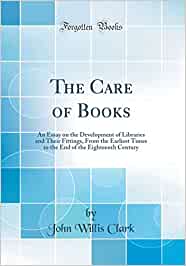
We could start with an almost ancient book itself now, which is JW Clark’s The Care of Books. This has as its subtitle “an essay on the development of libraries and their fittings, from the earliest times to the end of the 18th century.” I have the second edition, which was published by Cambridge University Press in 1909 and it’s well illustrated with photographs and line drawings. It is an absolutely fantastic historical survey, very detailed, very meticulous scholarship.
He goes and visits all the libraries he discusses, right from the ancient world. He’s in an era which is just learning about the excavations in Mesopotamia by Austen Henry Layard, which uncovered the libraries of Ashurbanipal. That had happened 40 years before, and the cuneiform tablets which were in those libraries and archives had been brought back to London, to the British Museum, for decipherment. He picks up on this knowledge and also talks about libraries that are better known, like Hadrian’s Library at Athens.
A lot of it is about famous libraries in Britain, like the Oxford and Cambridge college libraries. He’s writing from Cambridge, where he’s an architectural historian and writes a famous architectural history of Cambridge. He is also reading literary texts to pick up snippets of information about how libraries were organized or managed, or how writers engaged with libraries. I still go to this book for basic information as a starting point. Someday, I’d quite like to update it in the kind of detail that he has. He pulls a whole variety of sources to give this long overview over 2,000 years.
In a way, it has the same structure as your book, Burning the Books, in the sense that you’ve got that arc of history, though it sounds as if his has an architectural emphasis, whereas yours is more about the fragility of knowledge?
I’d say his book is not purely an architectural history because he does talk about the systems that librarians put in place in order to organize them. He thinks in three dimensions and looks for evidence, not just of the layout of the library in architectural terms, but in the fittings too: What kind of desks did they have?
What kind of seats did they have? What kind of catalogues did they have and how were they arranged? How were the books organized on the shelves? It’s more of a practical guide to how libraries were organized in the past. It doesn’t quite get to the more philosophical detail of the organization of knowledge, classification schemes and things like that. Nor does it talk a lot about the profession of librarian: how did these early librarians get taught their trade? What was the relationship between librarians in monasteries and scriptoria?
Those kinds of things aren’t really dealt with in his book, but it’s moving towards that. More recent scholarship is much more fragmentary. There are very detailed articles, or there’s the Cambridge History of Libraries in Britain and Ireland, for example, which I wrote a chapter in the first volume, which pulls everything together. But in terms of a single, holistic way of reading about the history of libraries this is still a fantastic book. He writes extremely well, and it’s well-footnoted and extremely well-illustrated, both with drawings and photographs.
I think being able to envisage how they’re organized is an important aspect of libraries because they are three-dimensional. He really helps the reader with those illustrations ... (cont. go to link)