Sprint: How to Solve Big Problems and Test New Ideas in Just Five Days
Curated from: books.google.com
Ideas, facts & insights covering these topics:
13 ideas · 5.9K reads

"Good ideas are hard to find. And even the best ideas face an uncertain path to real-world success. That's true whether you’re running a startup, teaching a class, or working inside a large organization."

Working together in a sprint
Working in a sprint as a startup means shortcutting the endless debate cycle and compressing months of time into a single week. Instead of waiting to launch a minimal product to understand if an idea is any good, you get clear data from a realistic prototype.
The superpower working in a sprint: it fast-forwards you into the future to see your finished product and customer reactions, before making any expensive commitments.
Running your own sprint
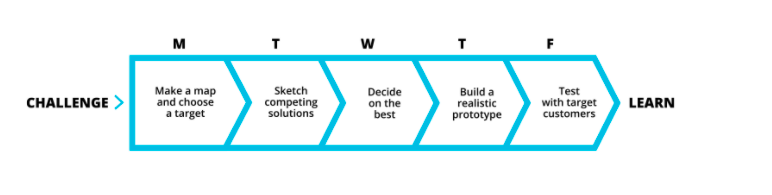
- On Monday, you’ll map out the problem and pick an important place to focus.
- On Tuesday, you’ll sketch competing solutions on paper.
- On Wednesday, you’ll make difficult decisions and turn your ideas into testable hypotheses.
- On Thursday, you’ll hammer out a realistic prototype.
- And on Friday, you’ll test it with real live humans.
The bigger the challenge, the better the sprint
Challenging situations where sprints can help:
- High stakes: you’re facing a big problem and the solution will require a lot of time and money. A sprint is your chance to check the navigation charts and steer in the right direction before going full steam ahead.
- Not enough time: You’re up against a deadline. As the name suggests, a sprint is built for speed.
- Just plain stuck: Some important projects are hard to start. Others lose momentum along the way. In these situations, a sprint can be a booster rocket: a fresh approach to problem-solving that helps you escape gravity’s clutches.

Solve the surface first
The surface is important. It’s where your product or service meets customers. Human beings are complex and fickle, so it’s impossible to predict how they’ll react to a brand-new solution.
Get that surface right, and you can work backward to figure out the underlying systems or technology. Focusing on the surface allows you to move fast and answer big questions before you commit to execution, which is why any challenge, no matter how large, can benefit from a sprint.
A sprint resembles that perfectly orchestrated heist. You and your team put your talents, time, and energy to their best use, taking on an overwhelming challenge and using your wits (and a little trickery) to overcome every obstacle that crosses your path. To pull it off, you need the right team. You shouldn’t need a pickpocket, but you will need a leader and a set of diverse skills.
Time and space
One of the best aspects of a sprint: It gives you an excuse to work the way you want to work, with a clear calendar and one important goal to address.
There are no context switches between different projects, and no random interruptions.
Start at the end
Even when the future seems obvious, it’s worth taking the time on Monday to make it specific and write it down.
Consider these questions:
If you could jump ahead to the end of your sprint, what questions would be answered? If you went six months or a year further into the future, what would have improved about your business as a result of this project?

Remix and improve
We all want a flash of divine inspiration that changes the world—and impresses our teammates. But amazing ideas don’t happen like that: great innovation is built on existing ideas, repurposed with vision.
In your sprint, follow this rule: remix and improve— but never blindly copy.
The power of sketching
Sketching is the fastest and easiest way to transform abstract ideas into concrete solutions. Once your ideas become concrete, they can be critically and fairly evaluated by the rest of the team—without any sales pitch.
And, perhaps most important of all, sketching allows every person to develop those concrete ideas while working alone.
Individuals working alone generate better solutions than groups brainstorming out loud. It allows for everyone to do research, find inspiration, think about the problem, and create unique ideas.
The sticky decision
Here are the five steps to go through in order to decide which solutions should be prototyped:
- Art museum: Put the solution sketches on the wall with masking tape.
- Heat map: Look at all the solutions in silence, and use dot stickers to mark interesting parts.
- Speed critique: Quickly discuss the highlights of each solution, and use sticky notes to capture big ideas.
- Straw poll: Each person chooses one solution, and votes for it with a dot sticker.
- Supervote: The Decider makes the final decision, with—you guessed it—more stickers.

The prototype mindset
Prototyping is all about creating an illusion. To prototype your solution, you’ll need a temporary change of philosophy: from perfect to just enough, from long-term quality to temporary simulation. This is the “prototype mindset,” and it’s made up of four simple principles:
- You can prototype anything.
- Prototypes are disposable: don’t prototype anything you aren’t willing to throw away.
- Build just enough to learn, but not more: a prototype is meant to answer questions, so keep it focused. You don’t need a fully functional product.
- The prototype must appear real: to get trustworthy results in your test, you can’t ask your customers to use their imaginations. You’ve got to show them something realistic.
Gather customer reactions
When it’s time to showcase your prototype to customers, you’ll want them to react naturally and honestly to what they believe is a finished product or service. Such reactions are solid gold, but feedback is not.
If the illusion of a real product is broken, customers switch into feedback mode. They’ll try to be helpful and think up suggestions instead of providing genuine reactions.
In the real world, your product will stand alone—people will find it, evaluate it, and use it without you there to guide them. Give them nudges, but don’t tell them exactly what to do. Seeing where customers struggle and where they succeed is useful.