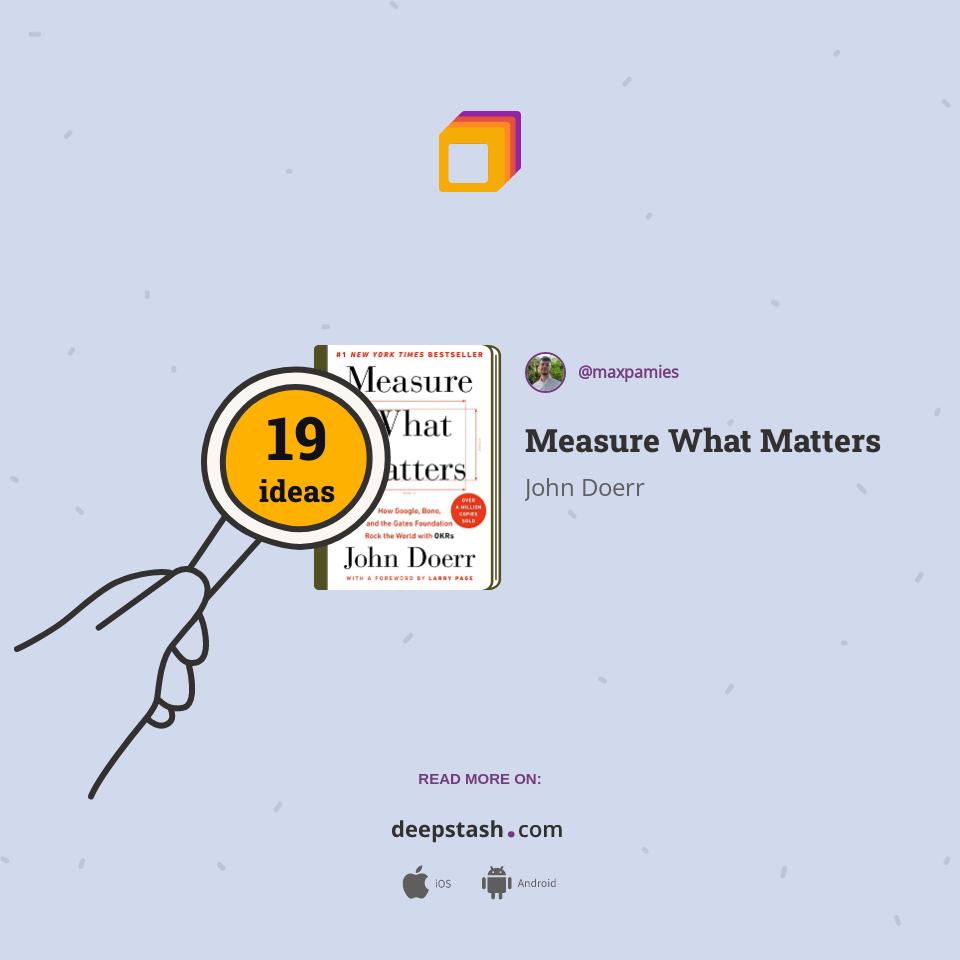
Measure What Matters
Curated from: books.google.com
Ideas, facts & insights covering these topics:
19 ideas · 14.7K reads
"Ideas are easy. Execution is everything."
What are OKRs?
OKRs is short for Objectives and Key Results. It is a collaborative goal-setting protocol for companies, teams, and individuals.
In the author's words: "A management methodology that helps to ensure that the company focuses efforts on the same important issues throughout the organization."
Objective is simply WHAT is to be achieved. These are significant, concrete, action oriented and (ideally) inspirational.
Key Results benchmark and monitor HOW we get to the objective. These are specific and time-bound, aggressive yet realistic, but most of all, measurable and verifiable.
"It is our choices... that show what we truly are, far more than our abilities."
OKRs Superpowers
The father of OKRs is Andy Grove, who implemented them in Intel, taking the company to the top of their sector.
OKRs consists of four superpowers, which will be discussed in more detail in the following sections:
- Focus and Commit to Priorities
- Align and Connect for Teamwork
- Track for Accountability
- Stretch for Amazing
"If we try to focus on everything, we focus on nothing."

Focus and Commit to Priorites
What is most important for the next three (or six, or twelve) months? That's what focus is all about.
The best OKR cadence is the one that fits the context and culture of your business.
Objectives are the stuff of inspiration and far horizons. Key results are more earth-bound and metric-driven.
Pair Key Results to Quantity & Quality to measure both effect and counter-effect.
Each Objective requires 3 to 5 Key Results to perform correctly.
As S. Sandberg says: "Done is better than perfect."
Summing up, priorization is key for management.
"We don't hire smart people to tell them what to do. We hire smart people so they can tell us what to do."

Align and Connect for Teamwork
OKRs give transparency and transparency seeds collaboration. They are the vehicle of choice for vertical alignment.
Fulfilling KRs = Achieving Objective.
Adverse effects of top-down OKRs:
- Loss of agility
- Lack of flexibility
- Marginalized contributors
- One-dimensional linkages
Solution: bottom-up OKRs!
"People who choose their destination will own a deeper awareness of what it takes to get there."
When leaders are attuned to the fluctuating needs of both the company and its employees, a mix of top-down and bottom-up OKRs is often optimal: "Connected companies are quicker companies."
"Transparency creates very clear signals for everyone."
"In God we trust; all others must bring data."
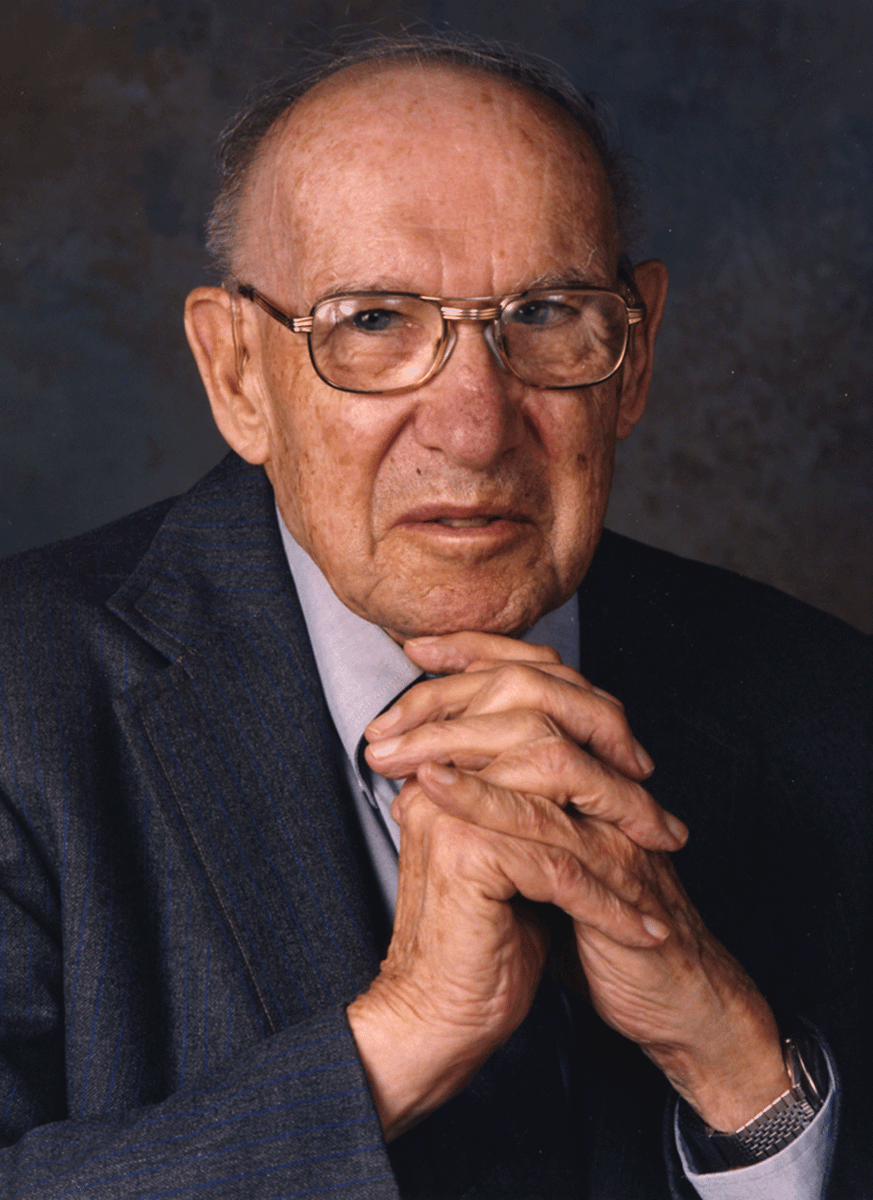
"Without an action plan, the executive becomes a prisoner of events. And without check-ins to reexamine the plan as events unfold, the executive has no way of knowing which events really matter and which are only noise."
"The biggest risk of all is not taking one."
Stretch for Amazing
OKRs push us far beyond our comfort zones. They lead us to achievements on the border between abilities and dreams.
Distinguish between:
- Committed OKRs: goals that must be attained 100 percent.
- Aspirational OKRs: and those that are stretching for a Big Hairy Audacious Goal.
Create an environment where individuals are free to fail without judgment. Replace incremental OKRs with exponential ones to reach 10x growth.
Design stretch OKRs to fit the organization's culture. A company's optimal "stretch" may vary over time, depending on the operating needs of the coming cycle.
Continuous Performance Management: OKRs and CFRs
CFRs stands for Conversation, Feedback & Recognition. They give OKRs their human voice.
By having regular conversations with your employees, you gain context for goal-analysis. Conversation consists of:
- Goal setting and reflection
- Two-way coaching
- Career growth
- Lightweight performance reviews
Feedback is key nowadays, by giving positive feedback you directly fulfill the need of empowerment of your employees and help them aim higher.
Closely related to Feedback, we find Recognition, which can be implemented through:
- Peer-to-peer recognition, by this culture of gratitude is born.
- Establishing clear criteria, recognize people for actions and results.
- Sharing recognition stories, like newsletters or company blogs.
- Frequent and attainable recognition, hailing smaller accomplishments too.
- Tying recognition to company goals and strategies, any organizational priority can be supported by a timely shout-out.
Culture
"Culture eats strategy for breakfast [...], it's what makes meaning of work." Any organization peak performance is the product of collaboration and accountability.
"Culture is a set of value and beliefs, as well as familiarity with the way things are done and should be done in a company. The point is that a strong and positive corporate culture is absolutely essential."
High-motivation cultures rely on a mix of two elements:
- Catalysts, actions that support work.
- Nourishers, acts of interpersonal support.
Companies that "out-behave" their competition will also outperform them.
"What keeps me going is goals."