Getting Things Done
Curated from: books.google.com
Ideas, facts & insights covering these topics:
17 ideas · 155.5K reads

Work No Longer Has Explicit Boundaries
In the last half of the 20th century, what "work" represented in the industrialized world was transformed from an assembly line, make-it and move-it kinds of activity to "knowledge work."
Back then, work was self-evident. Now there are no edges to most of our projects.
Basic Requirements for Managing Commitments
Managing commitments well requires the implementation of some basic activities and behaviors:
- If it's on your mind, your mind isn't clear. Anything you consider unfinished in any way must be captured in a trusted system outside your mind, that you know you'll come back to regularly and sort through.
- You must clarify exactly what your commitment is and decide what you have to do, if anything, to fulfill it.
- Once you've decided on all the actions you need to take, you must keep reminders of them organized in a system you review regularly.
Why Things Are On Your Mind
- You haven't clarified exactly what the intended outcome is.
- You haven't decided what the very next physical action step is.
- You haven't put reminders of the outcome and the action required in a system you trust.
Until those thoughts have been clarified and those decisions made, and the resulting data has been stored in a system that you absolutely know you will think about as often as you need to, your brain can't give up the job.
The Definition of "Stuff"
Stuff" means anything you have allowed into your psychological or physical world that doesn't belong where it is, but for which you haven't yet determined the desired outcome and the next action step.
The reason most organizing systems haven't worked for most people is that they haven't yet transformed all the "stuff" they're trying to organize. "Stuff" means these things are not controllable.

Managing Action
The essential element in managing all of your "stuff" is managing your actions. And it's very hard to manage actions if you haven't identified them.
A lack of time is not the major issue; the real problem is a lack of clarity and definition about what a project really is, and what the associated next-action steps required are. Clarifying things on the front end, when they first appear on the radar, rather than on the back end, after trouble has developed, allows people to reap the benefits of managing action.
The Five Steps Of The GTD Methodology
The stages we go trough as we deal with our work:
- Collect what has your attention
- Process what they mean and what to do about them
- Organize the results and put then where they belong
- Review as options for what we choose to do
- Do them.
The Collecting Process And Tools
- It's important to know what needs to be collected and how to collect it most effectively so you can process it appropriately.
- To make the collection phase work: Every open loop must be in your collection system and out of your head, you must have as few collection buckets as you can get by with and you must empty them regularly.
- The collection tools: physical in-basket, paper-based note-taking devices, electronic note-taking devices, voice-recording devices, e-mail.
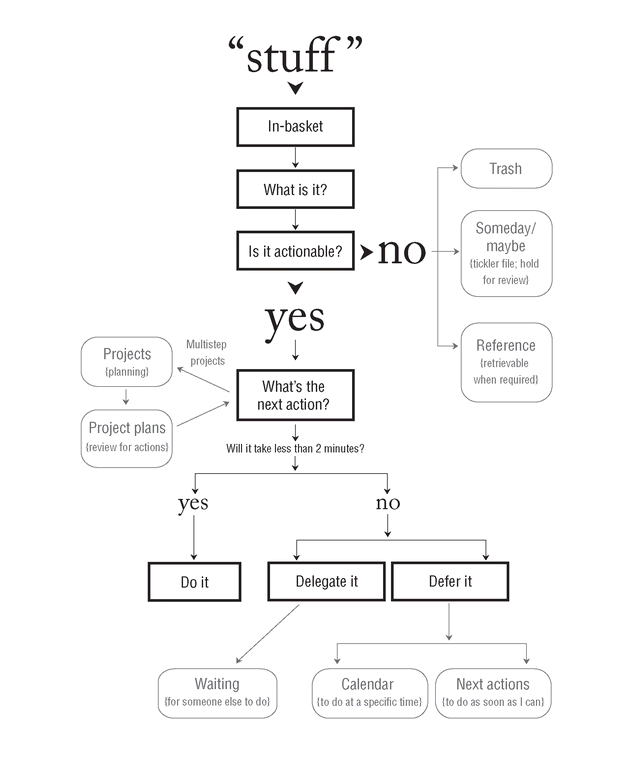
The GTD Decision Tree
Throughout your day, you’re constantly bombarded with information. All of these things are constantly competing for your attention.
Organize Actionable And Nonactionale Things
- Possible categories for nonactionable items" trash, incubation tools, and reference storage. If no action is needed on something, you toss it, "tickle" it for later reassessment, or file it so you can find the material if you need to refer to it at another time.
- To deal with actionable things, you need a list of projects, storage or files for project plans and materials, a calendar, a list of reminders of next actions, and a list of reminders of things you're waiting for.
All of the organizational categories need to be physically contained in some form.
The Weekly Review - A Critical Factor For Success
Everything that might potentially require action must be reviewed on a frequent enough basis to keep your mind from taking back the job of remembering and reminding.
Elements of the weekly review:
- Gather and process all your stuff
- Review your system
- Update your lists
- Get clean, clear, current, and complete.

The Key Ingredients of Relaxed Control
- Clearly defined outcomes and the next actions required to move them toward closure.
- Reminders placed in a trusted system that is reviewed regularly.
The Five Phases of The Natural Planning Model
Your mind goes through five steps to accomplish virtually any task:
- Defining purpose and principles
- Outcome visioning
- Brainstorming
- Organizing
- Identifying next actions.
Purpose: The Value Of Answering "Why"
- It creates decision-making criteria
- It aligns resources
- It motivates
- It clarifies focus
- It expands options, opens up creative thinking.
The Basic Steps For Developing A Vision
- View the project from beyond the completion date.
- Envision wild success.
- Capture features, aspects, qualities you imagine in place.
Brainstorming: Basic Principles
The basics principles can be summed up as follows:
- Don't judge, challenge, evaluate, or criticize.
- Go for quantity, not quality.
- Put analysis and organization in the background.
"When you start to make things happen, you really begin to believe you can make things happen. And that makes things happen."
How Do You Prevent Broken Agreements with Yourself
If the negative feelings come from broken agreements, you have three options for dealing with them and eliminating the negative consequences:
- Don't make the agreement.
- Complete the agreement.
- Renegotiate the agreement.
All of these can work to get rid of the unpleasant feelings.