The Ultimate Guide to Note-Taking
Curated from: katemats.com
Ideas, facts & insights covering these topics:
10 ideas · 67K reads
The Outline/List
Is a linear method of taking notes that proceeds down the page, using indentation or bullets to denote major and minor points.
Pros: it records content relationship in a way that is easy to review.
Cons: difficult to go back and edit information written in this system.
Works for: recording terms, definitions, facts and sequences, when taking notes on slides or readings.
The Sentence Method
The goal is to jot down your thoughts as quickly as possible. Format is kept to a minimum: every new thought is written on a new line.
Pros: Is like free writing for notes.
Cons: lack organization and notes can be hard to understand.
Works for: meetings or lectures that lack organization; when information is presented very quickly.
SQ3R (Survey, Question, Read, Recite, Review)
- Skim the material for bolded text, images, summaries, to produce a list of headlines;
- Each headline is then written in the form of a question;
- Record your “answers” to the reading questions under each corresponding header;
- Once you’ve finished reading the text, write a summary of the material from memory—this is the “recite” part of the process.
- Finally, review your notes to make sure you’ve completely grasped the concepts.
Works for: dense written material.
Visual mapping
A nonlinear system of note-taking that resembles a tree and root structure: ideas stem from one major concept and are connected by lines (or “branches”).
Pros: works well for visual learners; is tool for analytical-thinkers, because it outlines connections.
Cons: Time consuming; can get complex, doesn't work in every circumstances.
Works for: big-picture brainstorming sessions, planning essays and recording meetings.
Smart Wisdom
Instead of taking notes in full sentences, you record only keywords and place them in a chain that maps the thought process, written on a web-like grid, starting in the 1 o’clock position and working clockwise.
Pros: allows you to take notes in “real time”.
Cons: few sources for learning how to use it.
Works for: meetings and lectures; dyslexic learners.
Timelines
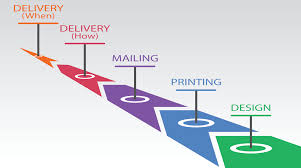
A continuum of dates and events.
However, timelines need not be limited to two-dimensions. Timelines can be multidimensional (i.e., date, relevant event, another event).
Work for: recording history or biography, but they can also be used to compare and contrast similar events.
Flow-chart
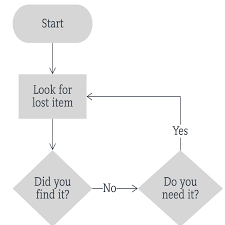
Represented by individual steps that start from a problem and lead to a solution.
Each step is denoted by a different kind of shape which symbolizes whether the note requires action or decision. Unlike the timeline, a flow chart can veer in multiple directions, leading to different scenarios.
Venn diagram
Usually comprise overlapping circle that represent sets. A set includes items that all share a specific characteristic.
Although there is no limit to the number of sets you compare, complicated Venn diagrams can be difficult to interpret
Works for: comparing and contrasting notes.
Fishbone diagram
- Identify the main problem (effect) and write this in a box center left of the page.
- Draw a thick horizontal arrow pointing to this box - the head and spine of the fish.
- Then brainstorm categories of causes that could lead to this effect.
- For each of these causes, draw a line branching off of the main arrow.
Works for: marketing, manufacturing or service industry for product design and quality defect prevention.
Adapting to context
Different types of information demand different styles of note-taking. There are lots of reasons to take notes: to retain information, to capture ideas, to problem solve or brainstorm, to visualize complex systems or concepts etc.
But what works for outlining a blog post might not work so great for brainstorming new ideas.