A World Without Email - Reimagining Work in an Age of Communication Overload
Curated from: books.google.com
Ideas, facts & insights covering these topics:
12 ideas · 22.2K reads
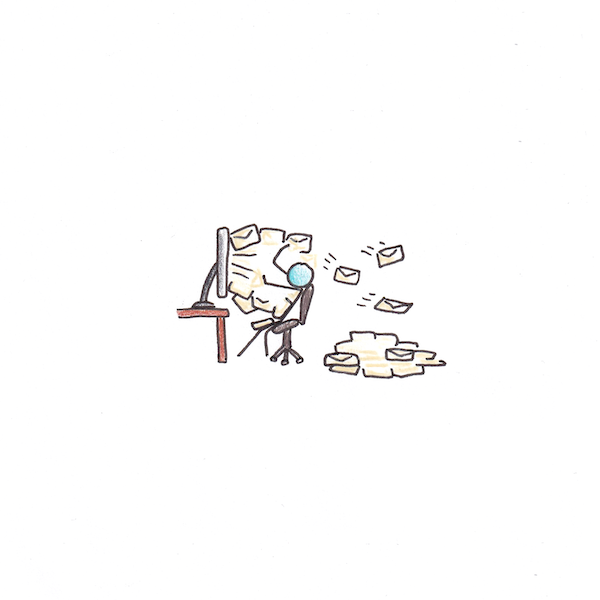
The Hyperactive Hive Mind
There is an underlying belief, in the knowledge sector, that hyper-communication equals work. We are part of a workflow centered around ongoing conversations fueled by unstructured and unscheduled messages delivered through digital communication tools like email and instant messenger services.
Constantly switching tasks and responding to email fuels our human need to rationalize what is happening around us, often helping us flee from the more nuanced and complex reality.
A terrible way to extract value from human neurons
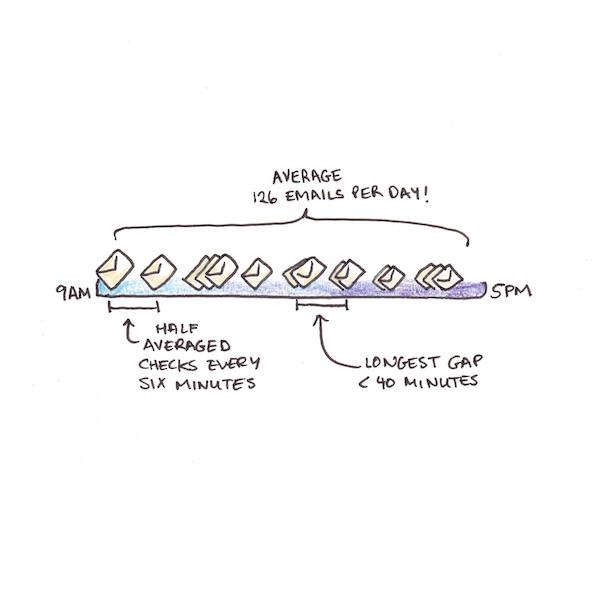
According to data gathered by the time-tracking software RescueTime
- Half of the users check communication applications like email or Slack every six minutes or less.
- The most common average checking time was once every minute.
- For half the users studied, the longest unbroken period of work was no more than forty minutes, with the most typical longest time being only twenty minutes.
- More than two-thirds of users never experienced an hour without an interruption.
- For business users, the average email volume was 126 messages per day.
Email reduces productivity
Attention switching costs are huge on our brains and workflows. This means that constantly jumping from one task to another brings with it a significant cognitive load that slows down our ability to focus and get the most out of our work. Yet, reactively replying to emails appears to be a “productive” use of our time on most occasions, due to the perceived convenience of this workflow in the short run.
Email makes us miserable
For those individuals who score high in neuroticism (a personality trait that is correlated with high levels of anxiety and negative emotions), the mere thought of batching email replies or using a more mindful approach to this tool can be stress-inducing.
This is because of the paleolithic nature of our social-animal brains, who feel FOMO (fear of missing out) and uneasiness at the mere thought of not replying instantly to interactions with other human beings who are part of our same tribe.

There's nothing fundamental about these newly increased workloads; they're instead an unintended side effect—a source of stress and anxiety that we can diminish if we're willing to step away from the frenetic back-and-forth that defines the hyperactive hive mind workflow.
Email has a mind of its own
The rate of spread of email since the 90s has been outstanding, almost to such a point that the hyperactive hive mind workflow has chosen us.
3 main drivers for this
- “The hidden costs of asynchrony”: synchrony might be “expensive” to set up, but constant asynchrony is much more expensive in the long term, as issues that may be solved in a couple of minutes tend to stretch in long threads of mindless back and forth.
- “The cycle of responsiveness”: Email fuels an endless feedback loop, that no one actually actively decided to implement rationally.
- "The caveman at the computer screen"
The attention capital principle
Attention capital is creating workflows that optimize the human brain's ability to add value to information. Not just to chase our own tails and send and receive more emails.
The optimal way to deploy our human brains is sequentially.
There are 2 main components to knowledge work:
- work execution, which requires more autonomy and is where knowledge workers use their brains and skills
- workflow, which is where you need less autonomy because it is the structure and coordination of the work
The process principle
Incorporating efficient production processes into knowledge work can make an incredible difference in increasing performance and minimizes ambiguity as to what to work on at any given time. Task boards like Asana and Trello are some of the key tools when it comes to setting up processes.
For a production process to be effective, it should be:
- Easy to review who's working on what and how that work is going
- Possible to make progress without lots of unscheduled communication
- Known procedures for updating assignments to minimize both unscheduled communication and ambiguity
The protocol principle
By spending more time setting up rules or protocols for work in advance, we can spend less effort coordinating the work at the moment.
An eg: The standard protocol meeting scheduling is "energy-minimizing email ping pong," which has a low energy cost at the moment but large cognitive costs long-term. Something like a scheduling link or open office hours can change that dramatically. Consider, customer support protocols like using team emails instead of personal ones
Also, consider email protocols like not promising to reply to every email and keeping emails short.
THE SPECIALIZATION PRINCIPLE
The specialization principle says that doing fewer things with higher quality and more accountability can significantly improve productivity. Basically, applying essentialism to knowledge work.
Less intense ways to further specialize are:
- Outsourcing what you don't do well
- Giving your team more autonomy
- Sprinting on specific projects
- Considering budgeting attention, workloads, or meeting time
Companies should also consider supercharging support staff and making those roles more efficient, building smart interfaces between specialists and support or different departments.
Once we understand the contours of our frustrations with knowledge work, we recognize that we have the potential to make these efforts not only massively more productive but also massively more fulfilling and sustainable.

Always keeping emails short is a simple rule, but the effects can be profound. Once you no longer think of email as a general-purpose tool for talking about anything at any time, its stranglehold on your attention will diminish.