The Circle of Safety
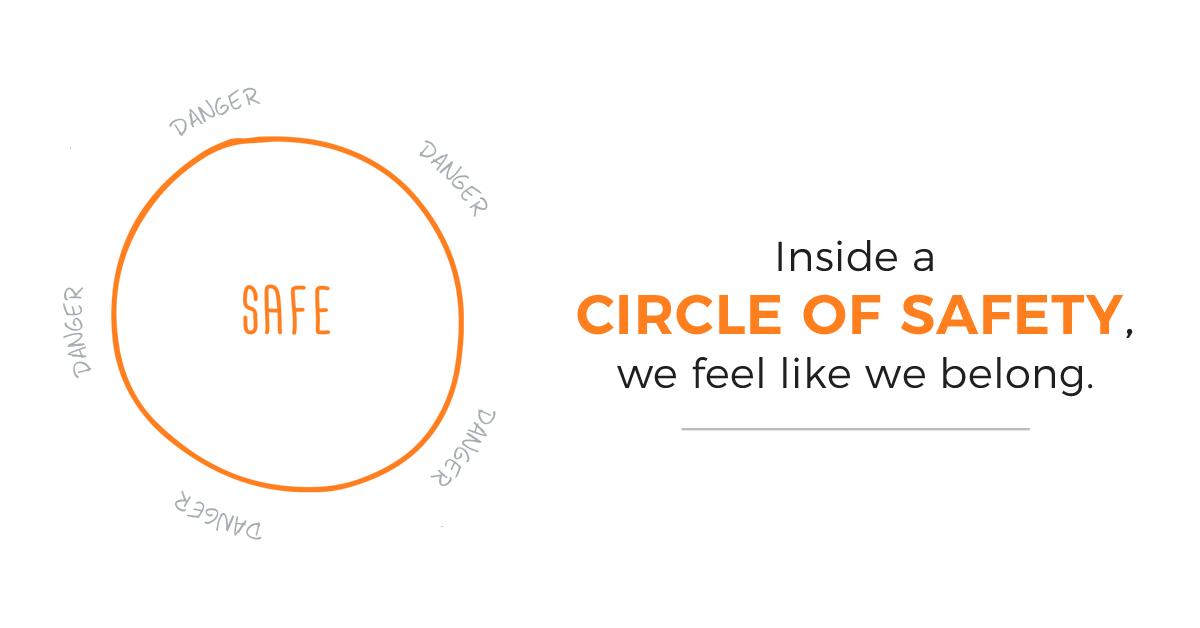
The first step to being a good leader is understanding that an organization is essentially a Circle of Safety. The people's insecurities vanish inside this Circle, but a bad leader will inevitably shrink or fracture it into multiple small ones.
Outside of the Circle, there is uncontrollable danger, but inside of it we can make it safe.

How to Lead
Efficiently leading an organization is something that many people struggle with these days. While there is no easy path to do it successfully, there are some guidelines and ideas that can surely help.
From Circles of Safety to happiness chemicals and empathy, follow me on this journey to learn how to be a better leader, one step at a time!

An Introduction to Happiness Chemicals
When discussing human behavior, we need to dig a bit into how the brain works. There are 4 primary chemicals for happiness:
- Endorphins
- Dopamine
- Serotonin
- Oxytocin
Let's see when each of these is released.

The "Selfish" Chemicals
The first 2 chemicals are called "selfish" because they are focused on personal survival.
- Endorphins mask physical pain with pleasure and are a response to stress or fear. An example of endorphins release is the "runner's high" or laughing - it actually causes pain, which is masked by endorphins and that's why if we laugh too much it eventually starts hurting.
- Dopamine causes the feeling of satisfaction after accomplishing something important to us. It is proportional to the effort.

The "Social" Chemicals
The other 2 chemicals are focused on socialization and our belonging to a group.
- Serotonin causes the feeling of pride when others like or respect us.
- Oxytocin is released to give us feelings of friendship, love, and deep trust. Without it, we couldn't love our children and wouldn't have a partner in the first place. It dictates the vulnerability we can afford to show to people. It is a long-lasting chemical and it is the reason why hand-shaking is so important in our society.
Oxytocin and serotonin grease the social machine. And when they are missing, friction results.

What Is Cortisol?
Aside from the happiness chemicals, there is also the notion of cortisol the stress hormone. Historically, it's released when danger is close and we need to get out of a life-threatening situation.
Unfortunately, unhealthy work environments lead to our bodies being inundated with cortisol, which causes our bodies to turn off "unnecessary" functions, such as digestion, growth and the immune system.
We physically feel sick in an unhealthy work environment.

Leaders in an Organization
People tend to chase the title of "leader" because it comes with great perks. These perks, however, come with the responsibility they have over their subjects or employees. Those who do not uphold this duty accordingly are weak leaders.
Any perk you receive in a company or organization is meant for your position, not for you.

Human Nature and Rules
Rules keep our society moving forward. But we don't really trust rules, we obey them. Trust is something inherently human due to oxytocin.
This is the reason we often hate bureaucrats. They always follow the rules and never show the human side our brain understands better.
We don’t just trust people to obey the rules, we also trust that they know when to break them.

Normalizing Layoffs
August 5, 1981, was the moment layoffs were normalized in the US by Ronald Reagan. He fired over 11,000 air traffic controllers on strike that day.
Layoffs have the goal of protecting commerce over people. Abstraction of people into employees makes us lose empathy and when we can't see the people we affect, we make decisions much easier.

Lifetime Employment
While layoffs can be a quick solution to make ends meet in financial statements, it does not mean they won't have long-term consequences.
The concept of "lifetime employment" guarantees an employee that he will never be fired. This was put into practice with good results. It will boost morale and communication; instead of firing people, you focus on why they perform worse and solve that.
Get to know the people you fire and you may change your mind.
A single death is a tragedy, a million deaths are a statistic.

The Magic Number
There is a magic number of close connections that humans can have. That number is 150. If one of an organization's offices or factories has more employees, the human connections grow cold and won't be as motivated.
This is no empirical estimation. Old hunter/gatherer tribes usually had 100-150 members. A company of marines consists of around 150 people.
When informality at the workplace is replaced by formality, it may be a hint that the group became too large and the Circle of Safety fractures.

Meet the People You Help!
Actually getting to see what impact your work has is infinitely more important than your boss complimenting you on it.
Due to human nature, putting money on the line is usually not as impactful emotionally as offering your time and energy to other people - our brains are not made to process the abstraction of money as easily as the implication of our peers.
Keep this in mind to motivate the group you lead. Human interaction is everything!

How Long Does It Take to Trust Someone?
We can never trust someone right away. Meeting a person for the first time naturally releases dopamine that masks how we actually feel about that person until the novelty fades; this is why we shouldn't get married after a week. Conversely, if after several years we still feel like we don't belong in a group, maybe it's time to let go.
Getting to know if we can trust someone takes more than 7 days and less than 7 years. These are the magic timeframes of trust.

Destructive Abundance
"Destructive Abundance" is the state where protecting the results is prioritized above protecting those who produce the results.
Companies get in this state because the leaders only care about the score but forgot why they decided to play the game in the first place. Challenge is replaced by temptation and people are replaceable.
Those at the top have all the authority and none of the information. Those at the bottom have all the information and none of the authority.

Authority and Integrity
Leaders have the vision and should delegate the authority to the ones with the information, that they can trust.
Trust requires integrity - the capacity of someone to consistently adhere to some moral values.
How you do anything is how you do everything.

Organizations are Inherently Social
In "Alcoholics Anonymous" people don't get sober until they complete the 12th (and last) step of the program, which involves helping another addict overcome his addiction. It is the helping of another human that motivates.
Similarly, your best days at work were not the ones when everything went perfect, but when everything went wrong, the hardship was shared and your team pulled through as a group.
Empathy is a second-by-second requirement to being a leader!
Human beings have thrived for fifty thousand years not because we are driven to serve ourselves, but because we are inspired to serve others.